

How to Tell If Roast Date Changes Your Coffee's Caffeine
Table of Contents
- What the Research Says About Roast Date and Caffeine
- Roast Date Versus Roast Level: Why the Two Get Confused
- Does Light Roast Have More Caffeine Than Dark Roast?
- How Degassing Shapes Flavor and Freshness After Roasting
- The Optimal Coffee Brewing Window After the Roast Date
- How to Store Coffee Beans for Maximum Freshness
- Choosing Your Next Bag of Roasted-to-Order Coffee
- Frequently Asked Questions
Last Updated: November 3, 2026
What the Research Says About Roast Date and Caffeine
Does roast date caffeine content matter? Most of the published evidence says the roast date itself does not change caffeine in any way a drinker would notice in the cup. The honest answer depends on what you mean by "roast date." Freshness changes how a coffee tastes. Caffeine is a separate question, and the research handles the two differently. 2024 study on caffeine content in filter coffee brews by degree of roast and brewing method
The most commonly reported finding in earlier literature is that caffeine content is unaffected by roast degree, although the same review notes that studies have reported differing results. Researchers publishing in Influence of Various Factors on Caffeine Content in Coffee (2021) concluded that the degree of roasting did not affect caffeine content in the brew. 2021 review of factors influencing caffeine content in coffee
Not every study agrees. Berry College researchers (2025) reported that coffee loses caffeine during the later stages of roasting, and that an ultra-light roast may contain the most caffeine. Berry College 2025 article on light and dark roast caffeine The honest takeaway is that the evidence is mixed, and the effect of roasting, if any, is small compared with other variables such as the amount of coffee you measure and the brewing method.
Roast Date Versus Roast Level: Why the Two Get Confused
Roast date is when the beans were roasted. Roast level describes how dark the beans were taken: light, medium, or dark. Most of the confusion comes from mixing these up.
Roast date mainly affects flavor and aroma, not roast date caffeine levels. Freshly roasted beans release carbon dioxide over the first days and weeks, a process called degassing, and that gas affects how the coffee extracts and tastes. Roast level changes the bean's chemistry and density, which affects how it measures and brews. Neither one is a reliable caffeine dial on its own.
Watch out: a bag labeled "dark roast" is not automatically higher or lower in caffeine. The roast level and the roast date are two separate facts, and the research does not support treating either as a simple caffeine indicator.
Does Light Roast Have More Caffeine Than Dark Roast?
This is the question most people actually want answered, and the research gives a qualified answer. Some studies find roast level has no consistent effect on brewed caffeine. Others, including the Berry College work, suggest lighter roasts may hold more caffeine because some caffeine is lost as roasting continues. Both findings can be true depending on how the coffee is measured and brewed.
For a practical choice, a light roast will not reliably give you a jolt that a dark roast cannot match. If caffeine matters most to you, the more reliable lever is how much coffee you use and which blend you choose. Our Max Caf Blend is built on Tanzania and India Robusta for a high-caffeine cup, and our Breakfast Blend + adds Robusta for extra caffeine.
Weight Versus Volume: Why Measurement Changes the Answer
Measurement is where many caffeine comparisons go wrong. Coffee dark roasts are less dense, so a scoop by volume contains less coffee by weight than a scoop of light roast. That means two cups brewed with the same scoop can differ in how much coffee they actually contain, even if the roast level has no effect on caffeine per gram.
If you want consistent caffeine, weigh your beans rather than scooping them. The difference in weight per scoop is often bigger than any caffeine difference between roast levels.
Debunking the Caffeine Burn-Off Myth
A common claim holds that dark roasting "burns off" caffeine, so dark roasts must be weaker. The research does not support this as a general rule. Roasting does change the bean, and some caffeine can be lost during later roasting stages, but the evidence does not show a dependable pattern where darker always means less. Treat burn-off as an unproven idea rather than a fact about your cup.
How Degassing Shapes Flavor and Freshness After Roasting
Degassing is the release of carbon dioxide from freshly roasted beans. Beans roasted only a few days ago often produce a lot of gas, which can make extraction uneven and give the cup a flat or sour edge. Many roasters suggest waiting a short period before brewing so the gas settles and the flavor balances out.
Roast date matters here because degassing changes taste, not caffeine. A coffee past its peak tastes stale, but it does not become caffeine-free. Good freshness keeps the flavor you paid for.
What most roast-date articles miss is that degassing also changes how efficiently water extracts caffeine, which is why fresh coffee can taste weaker or stronger than expected even when the caffeine dose is identical. Carbon dioxide trapped in the bean creates a barrier to water penetration. In a pour-over or drip brew, that barrier can channel water around the grounds and leave caffeine behind in the bed. In an espresso basket, fresh beans can produce gushers and uneven pucks for the same reason. The result is a cup that tastes thin or sour not because caffeine is missing, but because extraction was uneven.
A common pattern is that coffee brewed three to five days post-roast extracts less consistently than the same coffee brewed ten to fourteen days post-roast, when most of the CO2 has escaped. The caffeine per gram has not changed, but the amount that actually reaches the cup can vary by a noticeable margin. This is the interaction between roast date and brewing method that the roast-level debate ignores.
Watch out: if you grind fresh beans immediately before brewing, the grinder exposes more surface area and accelerates degassing, so the effect is smaller than if you brew whole beans in a method that relies on slow saturation. Either way, the fix is the same, give the beans a few days to settle, then weigh your dose so the caffeine input is consistent.
Caffeine itself does not degrade on a meaningful timeline after roasting. Studies that track caffeine in stored beans over weeks and months generally find it stable when the beans are kept sealed and away from moisture and heat. Stale coffee tastes dull because aromatics oxidize and oils go rancid, not because the caffeine molecule breaks down. That is the key distinction: roast date is a flavor clock, not a caffeine clock.
The Optimal Coffee Brewing Window After the Roast Date
For most people, the best flavor falls in a window that begins after the first few days of degassing and runs for several weeks after roasting. Beyond that window the coffee is still drinkable, but its aromatics fade. This is a flavor timeline, and it does not change caffeine content in any meaningful way.
To check freshness, look at the roast date on the bag, smell the beans, and taste a cup. Try these quick tests to see if your coffee is still fresh. If the aroma is muted or the cup tastes flat, the coffee has likely passed its best brewing window.
How to Store Coffee Beans for Maximum Freshness
Storage protects flavor more than it protects caffeine. Read detailed advice on keeping roasted beans fresh. The main enemies are air, moisture, heat, and light.
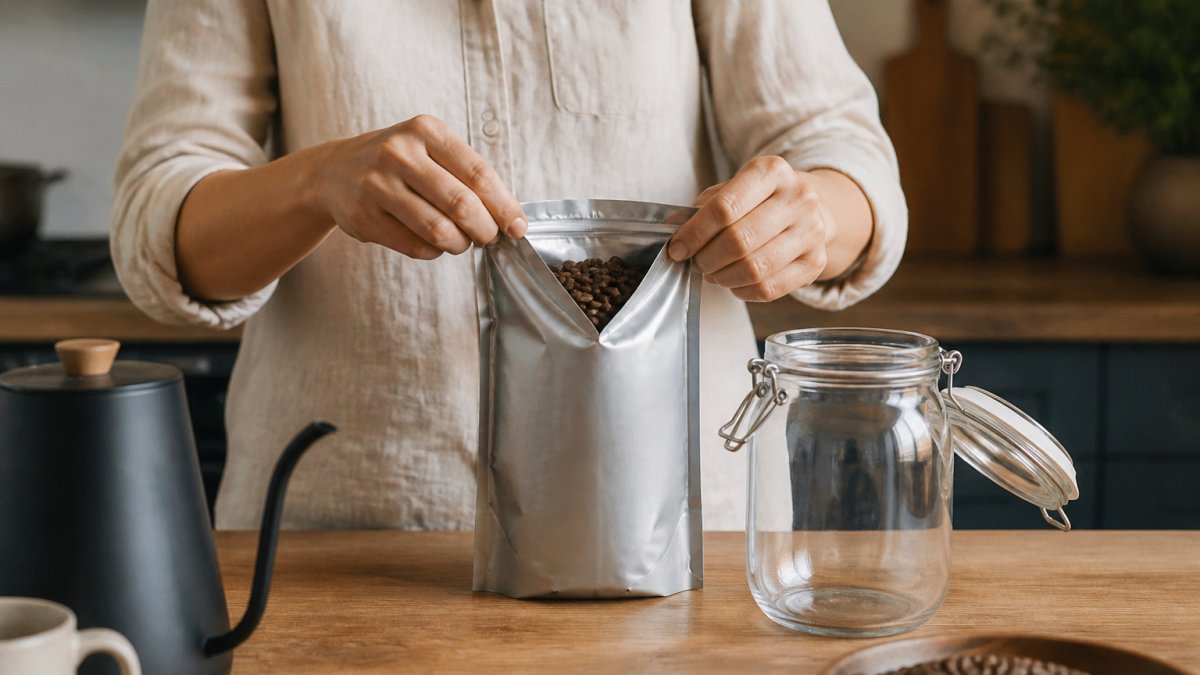
- Keep beans in an airtight container, ideally one that lets trapped gas escape without letting air in. See which airtight containers actually preserve freshness.
- Store the container in a cool, dark cabinet away from the stove and the sink.
- Buy amounts you will use within a few weeks, and avoid grinding until just before brewing.
Watch out: refrigerating or freezing beans exposes them to moisture when you open the container, which can dull the flavor. If you keep beans cold, bring them to room temperature before opening.
The article's storage advice comes down to four main enemies of flavor, which are summarised below.
| Factor | Effect on beans | Practical fix |
|---|---|---|
| Air | Oxidizes aromatics | Use an airtight container |
| Moisture | Dulls flavor | Avoid opening cold beans |
| Heat | Speeds staleness | Store away from stove |
| Light | Degrades beans | Keep in a dark cabinet |
Choosing Your Next Bag of Roasted-to-Order Coffee
Because roast date mostly shapes flavor, the best way to get a fresh cup is to buy coffee roasted close to when it ships. Compare fresh roasted coffee with grocery store options before you choose a bag. Our beans are roasted to order. Learn how to buy roasted-to-order coffee online step by step. If you are weighing the options, our Fresh Roasted Coffee vs Grocery Store comparison lays out the differences, and Buy Roasted to Order Coffee Online guide walks through ordering.
For a caffeine-forward pick, start with the Max Caf Blend or the Breakfast Blend +. For a darker, slow-roasted cup, the Italian Roast is our darkest option. Whichever you choose, weigh your dose, brew it fresh, and let the roast date guide your flavor expectations rather than your caffeine expectations.
Frequently Asked Questions
Does coffee roast date affect caffeine content?
Based on the research reviewed, the roast date itself has not been shown to meaningfully change caffeine content. A 2024 study in PubMed Central, reviewing filter coffee brews, notes that the most commonly reported finding is that caffeine content is unaffected by roast degree, though some studies have reported differing results. The roast date mainly affects flavor and aroma through degassing, which changes how the coffee tastes rather than how much caffeine it delivers. For a brew that tastes its best, use beans within the window recommended in this guide.
Does light roast coffee have more caffeine than dark roast?
The answer depends on how caffeine is measured. A 2021 study found roast degree did not affect caffeine content in the brew, while a 2025 Berry College report says coffee loses caffeine during later roasting stages and that an ultra-light roast may contain the most. Dark roasts are less dense, so a scoop of dark roast by volume weighs less and may deliver less caffeine per scoop. Weighing your beans gives the most consistent results.
How soon after the roast date should you drink coffee?
Many roasters suggest drinking whole beans roughly one to four weeks after roasting, when degassing has settled and flavor is most balanced. Coffee used too soon can taste sharp because carbon dioxide is still escaping. Coffee used much later can taste flat, even though caffeine levels are not expected to change much.
Do expired coffee beans contain less caffeine?
The research reviewed does not show that aging beans meaningfully reduces caffeine. What changes over time is flavor, since aromatic compounds fade as beans lose freshness. A stale bag may taste flat or papery even with the same caffeine content. Storing beans airtight, away from heat, light and moisture, helps preserve their character for longer.
