

How to Tell If Coffee Is Fresh: 7 Easy Tests
Table of Contents
- Why Freshness Matters More Than Most Drinkers Realize
- Check the Roast Date First (Batch Date Is Everything)
- How to Tell If Coffee Is Fresh Using Your Nose
- The Coffee Bloom Test: What CO2 Tells You About Freshness
- Visual Signs: Oils, Color, and Bean Appearance
- How Long Do Coffee Beans Last After Roasting?
- How to Store Coffee Beans Properly to Lock In Freshness
- Sensory Tasting Guide: Diagnosing Stale vs. Fresh in the Cup
Last Updated: August 30, 2026
Why Freshness Matters More Than Most Drinkers Realize
Most coffee drinkers ignore the one variable that controls everything: freshness. Fresh coffee retains volatile aromatic compounds, active carbon dioxide, and natural oils that produce a lively, complex cup. Stale coffee has lost those compounds to oxidation, leaving behind a flat, dull brew with muted flavor and sometimes a rancid aftertaste.
Freshness exists on a spectrum, not as a binary. Below are seven practical tests, from checking the roast date to diagnosing staleness in the cup, so you know exactly where your bag stands before brewing.
Check the Roast Date First (Batch Date Is Everything)
The roast date is the most objective data point on any bag of coffee and the first thing you should look for.
A roast date tells you when the beans were processed. A best-by date tells you almost nothing, as it's calculated from an arbitrary shelf-life estimate rather than the actual roast date. If a bag shows only a best-by date and no batch date, treat that as a red flag.
For whole bean coffee, the optimal brewing window starts around five to fourteen days after roasting. During the first few days, beans actively release carbon dioxide, which can interfere with extraction. After roughly three to four weeks, oxidation noticeably degrades flavor. Ground coffee degrades far faster: once ground, it goes stale within hours without proper storage.
What to look for on the label:
- A printed roast date or batch date (not just a best-by date)
- A roasting location or facility, signaling small-batch production
- A one-way valve on the bag, indicating the roaster understands degassing
How to Tell If Coffee Is Fresh Using Your Nose
Aroma is the fastest and most reliable freshness test available, requiring zero equipment.
Open the bag and inhale deeply. Fresh coffee has a complex, multi-layered aroma: fruity or floral top notes, a rich roasted base, and sometimes faint sweetness depending on origin. The smell should be assertive and lively.
Stale coffee smells flat, papery, or musty. In advanced oxidation, you may detect a rancid or cardboard-like odor from the breakdown of bean oils.
A practical nose test:
- Open the bag and seal it loosely around your face
- Squeeze gently to force air toward your nose
- Inhale, the aroma should hit immediately and be complex
- If you search for the smell or it smells like an old pantry, the coffee is past its prime
According to the Specialty Coffee Association's sensory resources, aroma accounts for a significant portion of the overall sensory experience in cupping evaluations.
The Coffee Bloom Test: What CO2 Tells You About Freshness
The bloom test is the most visually dramatic freshness indicator. When roasted, carbon dioxide becomes trapped inside the bean's cellular structure. After roasting, CO2 slowly escapes through degassing. Freshly roasted beans still contain significant CO2. When hot water hits those grounds, the gas releases rapidly, creating a bubbling dome of foam called the bloom. A strong, domed bloom that holds its shape for thirty to forty-five seconds signals a freshly roasted batch.
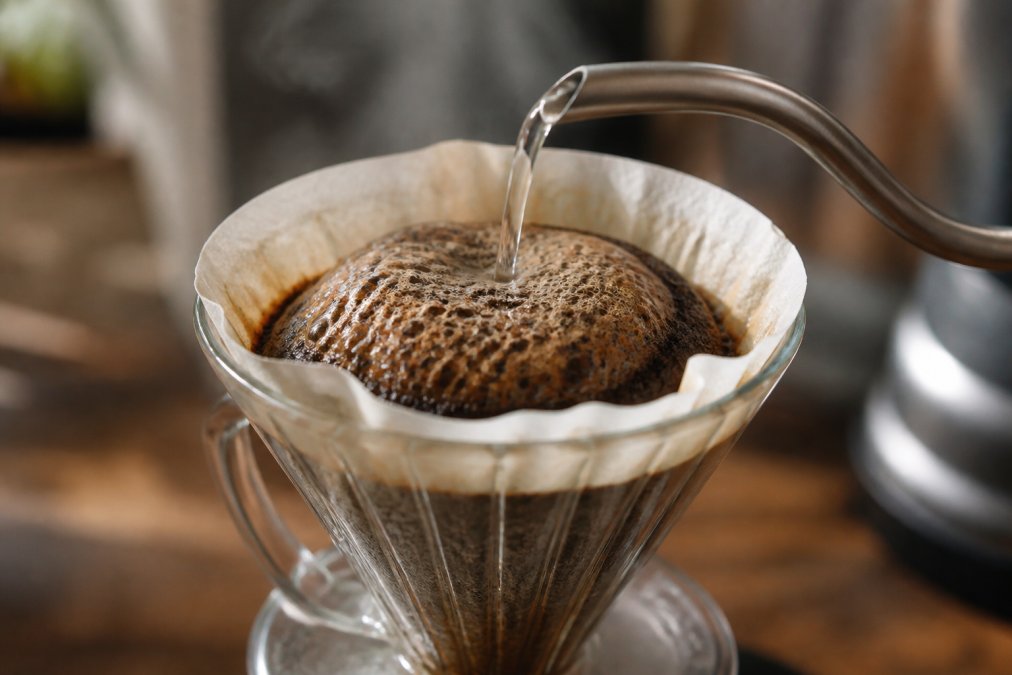
Stale coffee blooms weakly or not at all. If you pour hot water over grounds and the surface barely moves, the CO2 has already escaped.
How to run the bloom test:
- Heat water to around 200°F (just off the boil)
- Grind beans fresh immediately before brewing
- Add grounds to a pour-over dripper or French press
- Pour just enough water to saturate the grounds (roughly twice the weight of the coffee)
- Wait thirty seconds and observe
A healthy bloom rises noticeably above the rim and bubbles actively. A flat surface means stale coffee. A moderate bloom suggests drinkable but past-peak coffee.
Visual Signs: Oils, Color, and Bean Appearance
Fresh whole bean coffee has a specific visual profile that changes predictably as it ages.
Darker roasts show visible surface oils, a natural result of roasting pushing lipids to the surface. Those oils should look glossy and even, not tacky, dried out, or crystallized. Light roasts appear drier and more matte, which is normal. Look for uniformity: beans should be consistent in color within the same batch.
Signs of stale beans:
- A chalky, dusty coating on the bean surface (oxidized oils)
- Uneven color distribution within the same bag
- Beans that look shrunken or excessively dry
- Any visible moisture or clumping
Ground coffee clumping signals both moisture exposure and oxidation. Fresh ground coffee stored properly maintains texture and separation.
How Long Do Coffee Beans Last After Roasting?
Whole bean coffee stays fresh for approximately three to four weeks after the roast date when stored properly in an airtight container away from light, heat, and moisture. After four weeks, the coffee is still drinkable but noticeably flatter. By six to eight weeks post-roast, most volatile compounds have dissipated.
Ground coffee degrades much faster. Once ground, coffee should ideally be brewed within fifteen to thirty minutes. Stored in an airtight container, pre-ground coffee holds for a few days, but degradation from increased surface area exposure is significant.
According to the Coffee Quality Institute's guidance on post-harvest handling, storage conditions after roasting are as important as the roasting process itself in determining final cup quality.
Does Roast Level Change Shelf Life?
Dark roasts have a shorter effective shelf life than light roasts. Higher roasting temperatures break down more of the bean's cellular structure, so oils reach the surface faster and oxidize more quickly. A dark roast perfect at ten days may taste flat by three weeks. Light roasts retain more internal structure and hold flavor longer, often remaining peak quality for four to five weeks.
| Roast Level | Peak Freshness Window | Shelf Life (Whole Bean, Sealed) |
|---|---|---|
| Light | 7-21 days post-roast | Up to 5 weeks |
| Medium | 5-18 days post-roast | Up to 4 weeks |
| Dark | 5-14 days post-roast | Up to 3 weeks |
| Ground (any roast) | Best within 30 minutes | 2-5 days max |
How to Store Coffee Beans Properly to Lock In Freshness
The four enemies of fresh coffee are oxygen, moisture, light, and heat. Oxygen causes oxidation and rancidity. Moisture promotes mold and accelerates staling. Light and heat speed up every chemical degradation process.
The right storage approach:
- Transfer beans to an airtight container with a one-way valve immediately after opening
- Store in a cool, dark cabinet, not near the stove or window
- Never refrigerate: temperature fluctuations and ambient moisture cause more damage
- Freeze only large quantities for more than a month, in single-use portions never refrozen
- Buy smaller quantities more frequently rather than bulk
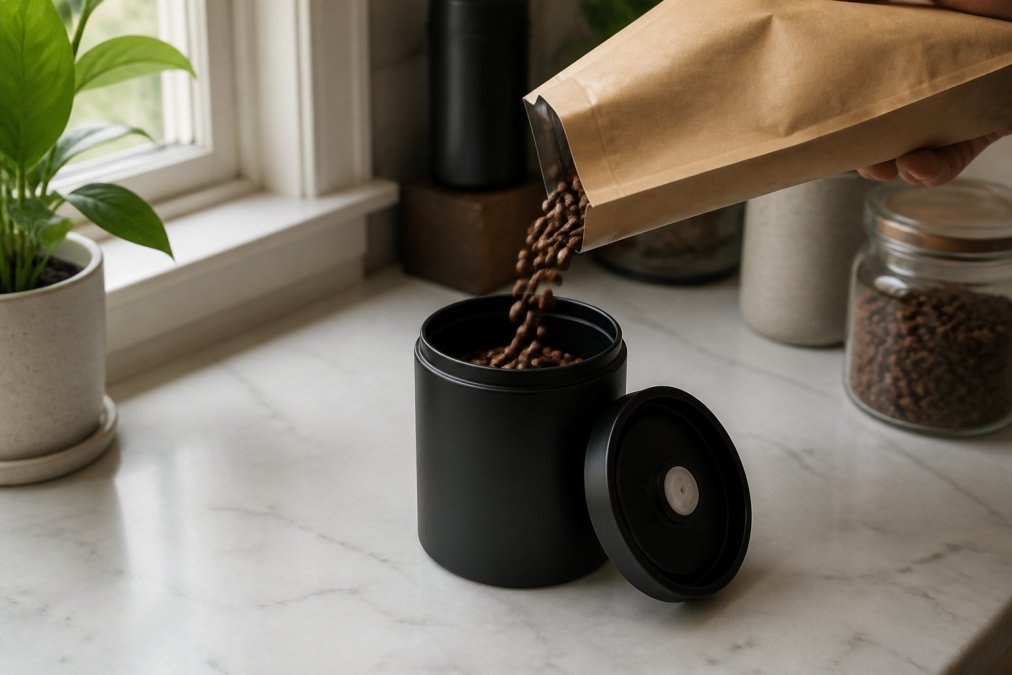
Black Cat Coffee Co.'s roasted-to-order model ensures beans arrive in their optimal degassing window, ready to brew at peak flavor.
Troubleshooting Your Storage Container
Problem: Coffee stales faster than expected despite using a container Likely cause: The container is not truly airtight. Plastic containers with simple snap lids allow oxygen exchange. Test by pressing the lid and checking for resistance.
Problem: Coffee tastes slightly off after storage Likely cause: The container has absorbed odors from previous contents. Rinse with hot water and baking soda, then dry completely before use.
Problem: Beans look oily and sticky inside the container Likely cause: This is normal for dark roasts stored correctly. Oils migrate to the surface during natural degassing. Clean the container regularly to prevent rancid oil residue from contaminating fresh batches.
Problem: Container has no one-way valve One-way valves allow CO2 from freshly roasted beans to escape without letting oxygen in. Without a valve, CO2 builds up and can push the lid open. Look for containers specifically designed for coffee storage.
Sensory Tasting Guide: Diagnosing Stale vs. Fresh in the Cup
Fresh coffee tastes lively and layered. Depending on origin, you might detect brightness, fruit notes, floral hints, chocolate, nuts, or caramel. The key quality is that something distinct happens on your palate, evolving as the cup cools. A well-extracted fresh coffee has a clean finish with no lingering bitterness.
Stale coffee tastes one-dimensional: flat, often bitter in a hollow way, with a short, forgettable finish. Advanced rancidity produces an unpleasant aftertaste.
Sensory diagnostic checklist:
- Aroma in the cup: Does steam carry a distinct, inviting smell? (Fresh = yes; Stale = faint or absent)
- First sip brightness: Is there a moment of liveliness on the front of the palate? (Fresh = yes; Stale = flat)
- Flavor complexity: Can you identify more than one flavor note? (Fresh = yes; Stale = one-note bitterness)
- Finish length: Does flavor linger pleasantly for a few seconds? (Fresh = yes; Stale = drops off or harsh aftertaste)
- Crema quality (espresso only): Is crema golden-brown and holds thirty seconds? (Fresh = yes; Stale = thin, pale, or absent)
Calibrate your palate by intentionally brewing a cup from a past-prime bag and comparing it side by side with a freshly roasted batch. The contrast is stark. As noted in the Specialty Coffee Association's cupping protocols, sensory analysis skills improve significantly with deliberate comparative practice.
You don't need formal training to develop sensory skills, you need repetition and attention. Brew the same coffee at different points in its freshness window and take notes. Within weeks, you'll have a reliable internal reference for what fresh coffee tastes and smells like.
For deeper grounding in coffee sensory science, the Coffee Quality Institute's professional development resources offer structured frameworks beyond casual tasting.
Stale coffee is one of the most common and most preventable problems in home brewing. The tests in this guide, from checking the roast date and running the bloom test to diagnosing the cup with a sensory checklist, give you a complete picture of where any bag stands. Black Cat Coffee Co. roasts to order specifically to eliminate the warehouse lag that leaves most grocery store coffee stale before it reaches your grinder. Shop Coffee and experience the difference that a genuine roast date makes in every cup.
Frequently Asked Questions
Q: Does the roast date on the bag actually matter?
A: Yes, the roast date is the single most useful freshness indicator on any bag of coffee. Whole beans are generally at their best between 4 and 21 days after roasting, once degassing has slowed enough for a stable flavor profile. A bag without a roast date, or one labeled only with a 'best by' date set 12 to 24 months out, tells you almost nothing about how to tell if coffee is fresh when you open it.
Q: How long does coffee stay fresh after it's ground?
A: Ground coffee loses most of its volatile aroma compounds within 15 to 30 minutes of grinding. Pre-ground coffee stored in an airtight container stays acceptable for about 1 to 2 weeks, but flavor fades noticeably after the first few days. For the freshest cup, grind whole beans immediately before brewing. This is one reason roast-to-order whole bean coffee can offer a superior experience compared to pre-ground options bought off a shelf.
Q: How can you tell if coffee beans have gone rancid?
A: Rancid coffee smells flat, musty, or faintly like cardboard or stale oil rather than the bright, complex aroma of freshly roasted beans. Visually, overly oily beans that have turned greasy or developed a dull, matte appearance can both signal age-related degradation. In the cup, rancid coffee tastes bitter and hollow with no sweetness or complexity. Running a quick bloom test is a reliable secondary check, stale beans produce little to no CO2 foam.
Q: What is the freshest coffee you can buy?
A: The freshest coffee available is small-batch, roasted-to-order coffee shipped directly from the roaster within days of roasting. This approach eliminates warehouse storage time and retail shelf time, both of which accelerate oxidation and flavor loss. Look for bags that display a specific roast date rather than a generic best-by date, and choose whole beans over pre-ground whenever possible to preserve aroma and flavor until the moment you brew.