

Fresh Roasted Coffee vs Grocery Store: 2026 Comparison
Table of Contents
- Fresh Roasted Coffee vs Grocery Store: A Side-by-Side Comparison
- How to Store Coffee Beans Properly for Maximum Freshness
- Coffee Roast Date vs Expiration Date: What Really Matters
- The Benefits of Small-Batch Coffee You Can Taste
- The Degassing Phase: Why Fresh Coffee Needs Time to Breathe
- Packaging Technology: How Valve Bags Protect Fresh Roasted Coffee
- Cost Per Cup: Fresh Roasted Coffee vs Grocery Store Beans
- Conclusion
- Frequently Asked Questions
Last Updated: September 11, 2026
Fresh Roasted Coffee vs Grocery Store: A Side-by-Side Comparison
Fresh roasted coffee is coffee that has been roasted within days of reaching your kitchen, rather than months. That single distinction drives nearly every difference in aroma, flavor clarity, and how the beans behave when you brew them. This comparison from Black Cat Coffee Co. breaks down what actually separates the two, from roast dates to packaging to cost per cup.
Walk into most grocery stores and you'll find bags with no roast date at all, just a "best by" stamp that can sit a year out from production. Specialty roasters print the roast date because it's the number that matters.
Here's the part most guides skip: coffee starts losing its best qualities within weeks of roasting, not months. A bag roasted last Tuesday and a bag roasted last spring are not the same product, even if the label looks identical. Below, we'll show you exactly how to tell them apart, how to store what you buy, and what the real cost difference looks like per cup.
| Factor | Fresh Roasted Coffee | Grocery Store Coffee |
|---|---|---|
| Roast date printed | Usually yes | Often absent |
| Time since roasting | Days to weeks | Months |
| Packaging | Valve bags, small batches | Often vacuum-sealed, mass-produced |
| Flavor clarity | High, origin-specific | Muted, consistent but flat |
| Cost per cup | Higher upfront | Lower upfront |
| Best for | Flavor-focused drinkers | Budget, convenience |
How to Store Coffee Beans Properly for Maximum Freshness
Storing coffee beans properly means protecting them from four enemies: oxygen, light, heat, and moisture. The single best move is keeping beans whole in an opaque, airtight container at room temperature, away from the stove.
A common mistake is dumping beans into the fridge or freezer in their original bag. Both introduce moisture and odors. If you must freeze, portion into airtight bags and let them thaw fully before grinding.
What most guides miss is that grinding is the real freshness cliff. Whole beans hold their aromatics for weeks; ground coffee starts fading within days because the surface area exposed to oxygen multiplies. Buy whole bean, grind right before brewing, and store the rest sealed.
Coffee Roast Date vs Expiration Date: What Really Matters
The roast date is the number that tells you how fresh coffee actually is; the expiration date tells you almost nothing useful. Most grocery bags carry only a "best by" date, which is typically set well beyond the point where flavor has already declined.
Here's the practical rule: coffee tastes best within roughly two to four weeks of the roast date for most brewing methods (peer-reviewed research). After that, it's still safe to drink, but the flavor notes flatten and the aroma fades.
That's why fresh roasted coffee from a roaster that stamps the date is easier to trust than a bag with a vague shelf-life window. You can't judge freshness you can't see. If a bag has no roast date, assume it's older than you'd like.
The Benefits of Small-Batch Coffee You Can Taste
Small-batch roasting gives a roaster tighter control over each batch, which shows up in the cup as clearer flavor and more consistent results. Instead of roasting enormous volumes at once, small batches let the roaster adjust for the specific beans in front of them.
The benefits of small-batch coffee come down to attention. A batch roaster can dial in roast level for a single-origin lot, coaxing out the acidity, body, and sweetness that mass production tends to smooth over. Commodity coffee is roasted for uniformity and shelf stability, not for flavor clarity.
Black Cat Coffee Co. roasts to order in small batches, which means your beans aren't roasted until you order them. That's the difference between coffee built to sit on a shelf and coffee built to taste like something.
The Degassing Phase: Why Fresh Coffee Needs Time to Breathe
Degassing is the release of carbon dioxide trapped inside beans during roasting, and it's the single most misunderstood part of the freshness conversation. Right after a roast, beans are saturated with CO2, a pound of freshly roasted coffee can release several liters of gas over the first few days. That gas has to go somewhere, and if it goes into your brew, it works against you.
Here's the mechanism. When hot water hits coffee grounds, the CO2 still trapped inside pushes water away from the particle surface. That resistance is what you see as the bloom, the puffy dome of bubbles in a pour-over or French press. A lively bloom is a sign of freshness, but too much of it means the water can't reach the soluble compounds that carry sweetness and acidity. The result is uneven extraction: some grounds over-extract into bitterness, others under-extract into sour, hollow cups.
This is why the popular advice to brew coffee the morning it's roasted is wrong. A common pattern among roasters is to recommend a resting window before the beans hit their peak:
- Espresso: 5 to 14 days after roast. Espresso is the most sensitive method because the short, pressurized shot magnifies any inconsistency. Too-fresh beans produce gushing, thin, sour shots that no grind adjustment fully fixes.
- Pour-over: 3 to 10 days after roast. The longer contact time is more forgiving, but a 24-hour-old bean still blooms so aggressively that the bed can channel.
- French press: 2 to 7 days after roast. Immersion brewing tolerates fresher coffee better than espresso, but the same CO2 interference shows up as a flat, muted cup if you brew too soon.
- Cold brew: 7 to 21 days after roast. The long, cold extraction is the most forgiving, and many drinkers find slightly rested beans give a cleaner, sweeter concentrate.
So freshness isn't a single point, it's a window. Peak flavor sits after degassing has slowed but before oxidation has taken hold. For most methods, that sweet spot runs roughly day 4 through day 21 post-roast, and it shifts earlier for immersion brewing and later for espresso.
A practical test: if your shots are spraying and sour no matter how you adjust the grind, the beans may simply be too fresh. Let them rest another few days and try again. If the bloom goes flat and the cup tastes papery or cardboard-like, you've crossed the other edge of the window into oxidation. The bloom you see when hot water hits fresh grounds is degassing in action, and reading it tells you which side of the window you're on.
Packaging Technology: How Valve Bags Protect Fresh Roasted Coffee
The bag is not a container, it's a freshness strategy, and the format a roaster chooses tells you exactly what they're optimizing for. Three packaging approaches dominate the shelf, and they solve different problems.
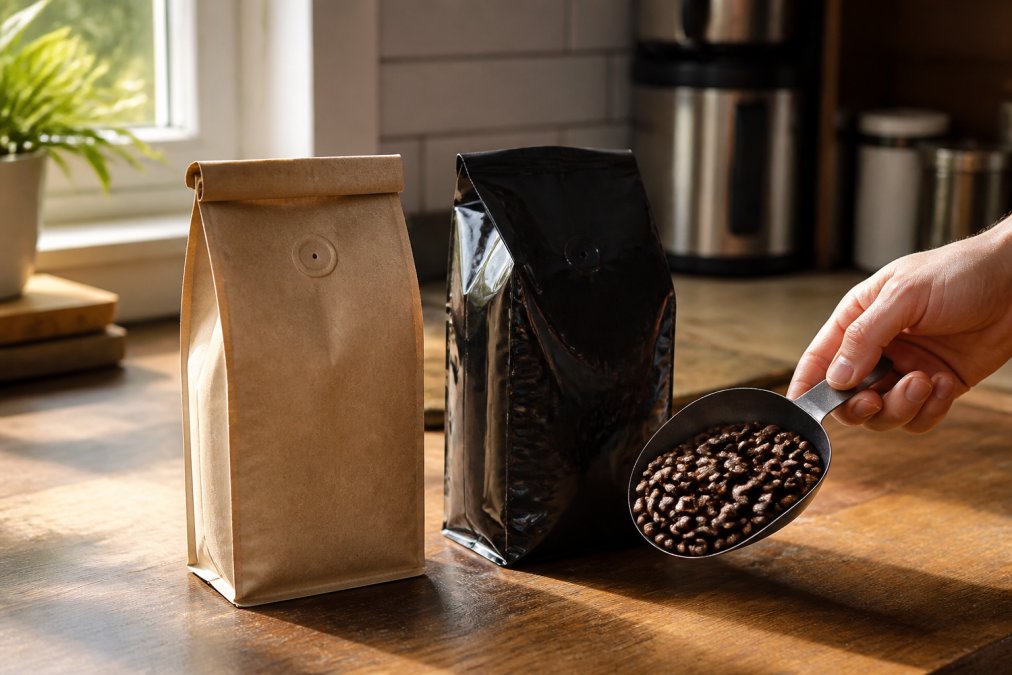
One-way degassing valve bags. A small valve on the front of the bag is a one-way door: CO2 escapes as the beans degas, but outside air can't get back in. Without it, a sealed bag of fresh coffee would inflate and eventually burst. The valve lets roasters pack coffee within hours of roasting instead of waiting days for degassing to finish. The catch is that a valve bag is not oxygen-proof. Standard multilayer film still lets a small amount of oxygen permeate over time, which is why valve bags are built for coffee that will be brewed within weeks, not months.
Vacuum-sealed bricks. The classic grocery format pulls a hard vacuum and collapses the bag into a brick. Removing the air removes the oxygen that drives staling, which is why vacuum bricks can hold up for many months. The trade-off is pressure: the vacuum crushes the beans and can force aromatic oils to the surface, and the format is typically paired with darker roasts that hide the resulting flavor loss. It's a shelf-life solution, not a flavor solution.
Nitrogen flushing. This is the most common approach in mass-market coffee today. The packer fills the bag with nitrogen, an inert gas, displacing the oxygen before sealing. Nitrogen flushing can push residual oxygen down to a very low level, which slows oxidation dramatically and extends shelf life well past what a simple valve bag achieves. It's genuinely effective at preventing staleness. What it cannot do is bring back the volatile aromatic compounds that fade in the days and weeks after roasting. Nitrogen flushing preserves what's left; it doesn't preserve peak flavor.
Here's the honest comparison. If your goal is a bag that tastes acceptable six months from now, nitrogen flushing and vacuum sealing win. If your goal is a bag that tastes like the roaster intended, bright, aromatic, origin-specific, you want coffee that was packed close to its roast date in a valve bag and brewed within a few weeks. The packaging is doing its job either way; the question is which job you care about.
how one-way degassing valves work
The practical takeaway: packaging is a signal. A valve bag with a printed roast date says the roaster expects you to brew this soon and wants you to know when it was roasted. A vacuum brick or a nitrogen-flushed bag with only a "best by" date says the roaster expects it to sit on a shelf. For flavor, the valve bag with a date wins, not because the technology is superior in the abstract, but because it's paired with coffee that hasn't been given months to fade.
Cost Per Cup: Fresh Roasted Coffee vs Grocery Store Beans
Fresh roasted coffee usually costs more per bag, but the per-cup math is closer than the sticker price suggests. A 12-ounce bag brewed at roughly two tablespoons per cup yields about 16 to 20 cups, so the gap narrows fast (peer-reviewed research).
Grocery store beans win on upfront price and convenience. Specialty roasters win on flavor, aroma, and the fact that you're paying for beans at their best rather than beans that have been aging for months. Pricing on both sides depends on origin, roast, and quantity, so check current prices before comparing.
For drinkers who treat coffee as a daily ritual rather than a caffeine delivery system, the per-cup premium buys a noticeably better cup. That's the honest trade-off, and it's worth naming plainly.
Conclusion
The gap between fresh roasted coffee and grocery store beans isn't marketing, it's chemistry: roast dates, degassing, and packaging all decide what ends up in your cup. If you want coffee at its peak, you need beans roasted recently and stored well.
Black Cat Coffee Co. roasts to order in small batches, so your coffee ships close to its roast date instead of sitting on a shelf. With carefully sourced beans, valve-sealed packaging, and fast, reliable delivery, you get maximum flavor and aroma in every cup. Shop Coffee with Black Cat Coffee Co. and taste the difference freshness makes.
Frequently Asked Questions
Is fresh roasted coffee actually better than grocery store coffee?
Yes, for flavor and aroma. Fresh roasted coffee reaches peak freshness within 4 to 14 days after roasting. Grocery store beans often sit on shelves for months, losing their volatile oils and developing stale, flat flavors. The difference is most noticeable in single-origin beans, where subtle flavor notes like acidity and body disappear over time. If you drink coffee daily, fresh roasted coffee delivers a noticeably more complex and enjoyable cup.
How can you tell if coffee beans are fresh?
Check the roast date, not the expiration date. Fresh beans have a visible roast date within the last two weeks. They also feel dense and smell strongly of coffee when you open the bag. A quick test: drop a few beans in hot water. Fresh beans release carbon dioxide and bubble actively, a sign of the degassing phase. Stale beans barely react. For grocery store coffee, look for brands that print roast dates rather than generic best-by dates.
Does coffee go bad after the roast date?
Coffee does not spoil like milk, but it loses flavor quality. After roasting, beans begin oxidizing and releasing carbon dioxide. Peak freshness lasts about 2 to 4 weeks for whole beans. After that, flavor decay accelerates, especially if the beans are ground. Proper storage in an airtight, opaque container away from heat and moisture can extend freshness to 6 weeks or more. For best results, buy only what you will drink within a month.
Why does grocery store coffee often taste stale?
Grocery store coffee tastes stale because of time and packaging. Mass-produced coffee is roasted in large batches, then distributed through warehouses and retail shelves. By the time you buy it, the roast date may be months old. Many brands use vacuum-sealed or valve packaging, but once opened, oxidation begins immediately. Commodity coffee also uses lower-grade beans, which lack the flavor clarity and complexity of small-batch, single-origin offerings.
What are the benefits of buying coffee roasted-to-order?
Roasted-to-order coffee ships within days of roasting, so you receive beans at or near peak freshness. This preserves aroma, acidity, and body. You also get transparency: you know the roast date and origin. Small-batch roasters often use higher-grade beans and roast in smaller quantities, which allows for better quality control. The result is a more consistent, flavorful cup compared to commodity coffee that has sat on a shelf for weeks.