

Why Specialty Coffee Tastes Better: A 2026 Guide
Table of Contents
- Specialty Coffee vs Commercial Coffee: What's the Difference?
- How Bean Quality and Origin Shape Flavor
- The Science of Acidity, Sweetness, and Aromatic Oils
- Water Chemistry: The Variable Most Brewers Ignore
- How to Brew Specialty Coffee at Home
- Best Coffee Beans for Home Brewing
- The Sensory Experience: Taste, Mouthfeel, and Aftertaste
- Sustainability and Ethical Sourcing as a Flavor Factor
- Frequently Asked Questions
Last Updated: September 12, 2026
Specialty Coffee vs Commercial Coffee: What's the Difference?
Specialty coffee scores 80 or above on the Specialty Coffee Association's 100-point scale, graded for defects, flavor clarity, and traceability from a single known origin (sca.coffee). Commercial coffee is graded by commodity standards, where defects are tolerated and origin is blended away. That threshold explains most of the taste gap, and this guide from Black Cat Coffee Co. breaks down why specialty coffee tastes better.
The difference starts before roasting. Commercial beans are grown for volume and picked in bulk, often including underripe and overripe fruit. Specialty producers pick selectively, process with intention, and document the lot.
Most guides blame brewing technique for a flat cup when the problem started at the farm. You can't brew flavor out of a bean that never had it.
Specialty Coffee Association's cupping standards and green coffee grading protocol
Bean Quality and Origin
Bean quality combines variety, growing conditions, harvest timing, and defect rate in a green coffee lot. Origin shapes flavor before processing starts: Ethiopian beans tend toward floral and citric notes, Colombian lots toward caramel and red fruit.
Commercial blends exist to hit a consistent, neutral taste at low cost. Specialty lots are selected because they taste like something specific.
Freshness and Roast Date
Roast date matters more than most labels admit. Coffee loses aromatic oils and volatile compounds within days of roasting, and supermarket bags often sit for months. A "best by" date tells you almost nothing about when the coffee was roasted.
Roasted-to-order coffee reaches you closer to peak flavor. That's the premise behind Black Cat Coffee Co.'s small-batch model: roast after you order, ship fast, and let the coffee arrive at its best rather than its most shelf-stable.
How Bean Quality and Origin Shape Flavor
Bean quality is the ceiling on what a coffee can taste like. A high-grown, hand-sorted micro-lot has more sugar development and complex acids than a mass-harvested commercial lot, and no brewing adjustment can raise that ceiling.
Three factors drive the gap:
- Varietal: Heirloom and Bourbon varieties develop different sugar and acid profiles than high-yield commercial cultivars
- Altitude and climate: Slower cherry maturation at higher elevations builds denser beans with more concentrated flavor
- Processing method: Washed, natural, and honey processing each steer the final cup toward different tasting notes
A common mistake is assuming "single origin" means better. It means traceable, not necessarily excellent; the grade and roast still decide the outcome.
The Science of Acidity, Sweetness, and Aromatic Oils
Perceived sweetness and pleasant acidity are built in the cherry, reshaped by the roast, then extracted or left behind depending on how you brew. A specialty lot carries stored sugars (sucrose and fructose) and organic acids, chiefly chlorogenic, citric, malic, and sometimes phosphoric acid. Higher-elevation, slower-maturing cherries accumulate more of these precursors, the raw material for everything after.
Roast development is where acidity and sweetness trade places. In the Maillard reaction, amino acids and reducing sugars form hundreds of aroma compounds, the same browning chemistry behind seared meat and toasted bread. Past first crack, chlorogenic acids break down into quinic and caffeic acids: bright, fruity acidity if balanced, harsh and ashy if pushed. Sucrose caramelizes into brown-sugar, toffee, and chocolate tones. A light roast preserves fruit-forward acids; a darker roast converts more sugar into caramel and bitter byproducts. The roast level decides which compounds lead.
Aromatic oils are the volatile fraction, and they are why smell does most of the work. The compounds behind blueberry, jasmine, or dark chocolate are volatile organic compounds, and heat, oxygen, and time degrade them. That is why a bag opened a month after roast smells flat, and why grinding immediately before brewing matters: grinding exposes more surface area, and aromatics start leaving the moment the cell structure breaks.
Extraction is the final gate. Acids and fruity esters dissolve early; sugars and caramelized compounds in the middle; harsh, drying, bitter compounds last. Under-extract and you get the sour, thin early fraction; over-extract and you pull the bitter, hollow late fraction. The sweet spot is the middle band where sweetness, acidity, and body overlap, which is why grind size, water temperature, and brew time all move the same extraction curve. Balance is the goal: enough acidity for lift, sweetness for body, and aromatic complexity for an interesting finish. Commercial coffee mutes all three for consistency; specialty coffee accepts variability in exchange for a higher ceiling.
Water Chemistry: The Variable Most Brewers Ignore
Water makes up roughly 98% of brewed coffee, and its minerals change extraction more than most brewers realize. Magnesium and calcium pull coffee compounds into solution; too little and the cup tastes hollow, too much and it turns chalky and bitter.
The Specialty Coffee Association recommends water with total hardness of roughly 50 to 175 ppm as calcium carbonate, with alkalinity near 40 ppm (sca.coffee). Most tap water sits outside that window.
If your specialty beans taste dull no matter how you adjust the grind, test your water before blaming the coffee. A carbon filter or re-mineralized brewing water can transform a cup more than a new grinder.
How to Brew Specialty Coffee at Home
Great home brewing means controlling a handful of variables and repeating them. You don't need expensive equipment to taste the difference between specialty and commercial coffee, but you do need consistency.
Total Time: 12-15 minutes Difficulty: Beginner to intermediate
What You'll Need:
- Freshly roasted whole beans with a visible roast date
- A burr grinder
- A digital scale
- A gooseneck kettle
- A pour-over dripper or French press
- Filtered or re-mineralized water
Step 1: Weigh your beans [Time: 1 minute] Use a 1:16 ratio as a starting point, so 20 grams of coffee to 320 grams of water. Eyeballing scoops is the fastest way to inconsistent cups.
Step 2: Grind fresh [Time: 1 minute] Grind immediately before brewing. Ground coffee loses aromatic oils within minutes, and pre-ground specialty beans waste most of what you paid for.
Step 3: Heat water to 195-205°F [Time: 3 minutes] Water temperature controls how aggressively compounds extract. Below 195°F, you under-extract and get sourness; above 205°F, you scorch the grounds and pull out bitterness.
Step 4: Bloom the grounds [Time: 30-45 seconds] Pour just enough water to saturate the grounds and wait. The bloom releases trapped carbon dioxide so the rest of the water can extract evenly.
Step 5: Pour in stages [Time: 3 minutes] Add the remaining water in slow, steady circles. Total brew time for pour-over should land around 3 minutes.
Expected Result: A cup with clear tasting notes, balanced sweetness, and a clean finish rather than a bitter or muddy aftertaste.
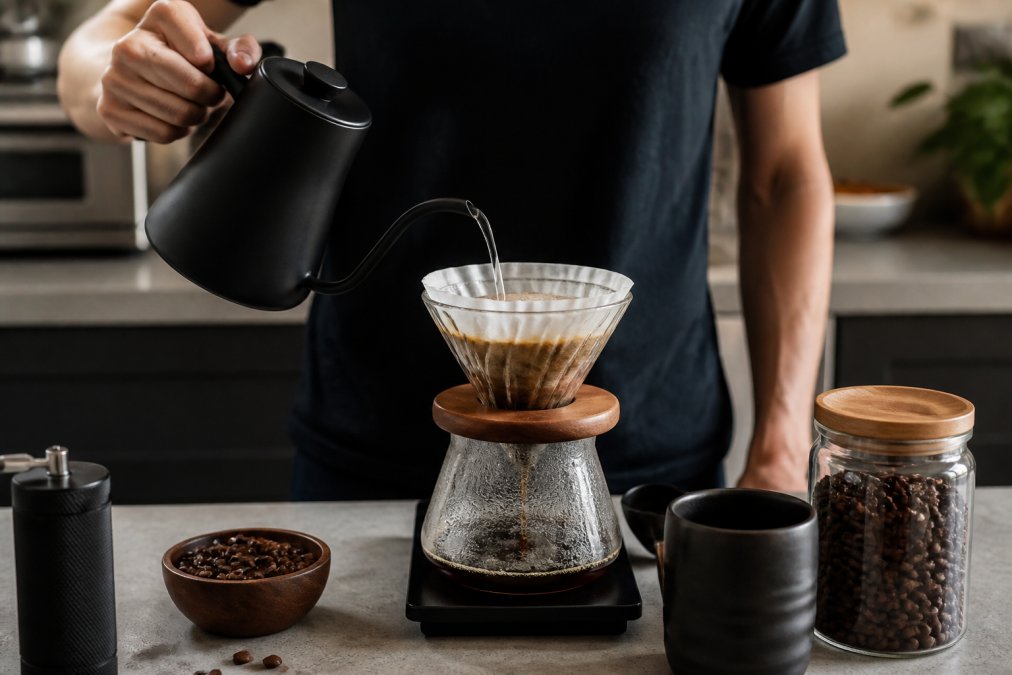
Grind Size and Brewing Variables
Grind size is the fastest lever you have. Finer grinds expose more surface area and extract faster; coarser grinds slow extraction. Sour and thin means grind finer; bitter and drying means grind coarser.
| Variable | Target | If It Tastes Sour | If It Tastes Bitter |
|---|---|---|---|
| Grind size | Medium (drip/pour-over) | Grind finer | Grind coarser |
| Water temperature | 195-205°F | Raise temperature | Lower temperature |
| Brew ratio | 1:16 coffee to water | Use less water | Use more water |
| Brew time | ~3 minutes pour-over | Extend contact time | Shorten contact time |
Change one variable at a time. Adjusting grind, temperature, and ratio together makes it impossible to know what fixed the cup.
Best Coffee Beans for Home Brewing
The best coffee beans for home brewing are freshly roasted, whole-bean, and matched to your method. Single-origin lots reward pour-over and French press by letting distinct notes come through; blends are more forgiving across methods.
A few practical selection rules:
- Check the roast date, not the "best by" date
- Buy whole bean and grind at home
- Match roast level to method: lighter roasts for pour-over, medium to dark for espresso and French press
- Buy in quantities you'll finish within a few weeks
This is where Black Cat Coffee Co.'s roasted-to-order approach helps. Because beans ship shortly after roasting rather than sitting in distribution, you're brewing closer to peak flavor instead of working around staleness. Their single-origin and blend lineup covers both the curious taster and the daily-ritual drinker.
The Sensory Experience: Taste, Mouthfeel, and Aftertaste
Most guides treat the sensory experience as a checklist: taste, mouthfeel, aftertaste. The more useful framing is physiological: what you call "flavor" is your brain assembling separate signals, and knowing which is which tells you what to fix when a cup disappoints.
Taste is the narrow channel. Your tongue detects only five basic tastes: sweet, sour, salty, bitter, and umami. Coffee engages mainly sweet, sour, and bitter. Everything else you experience as flavor, the blueberry, the jasmine, the cocoa, arrives through a different route.
Aroma is where flavor actually lives, and most of it happens retronasally. When you sip, volatile compounds travel up the back of your throat to the olfactory epithelium. This pathway is why coffee tastes like almost nothing when you have a cold, and why pinching your nose collapses flavor to a flat sour-bitter signal. Slurping aerates the coffee and pushes more volatiles into that path, which is why professional cuppers slurp deliberately. At home, swirling the cup and breathing out slowly after you sip does the same job.
Mouthfeel is a separate sense entirely. Body, texture, and astringency are touch and chemical irritation detected by the trigeminal nerve. Dissolved solids and oils give coffee its weight, which is why a French press cup feels heavier than a pour-over of the same beans. Astringency, the drying grip on your tongue, comes from compounds binding to saliva proteins and usually signals over-extraction or green coffee defects. Under-extracted coffee feels thin; over-extracted coffee feels rough.
Aftertaste is the diagnostic window. The finish lingers because aromatic compounds keep releasing from the coating in your mouth and throat. A clean, sweet finish that fades slowly suggests a well-extracted, defect-free bean. A bitter, papery, or metallic finish points to over-extraction, stale coffee, or a masked defect. Experienced tasters judge the finish last and weight it heavily.
Psychology is not a footnote. Expectation shapes perception: told a coffee is premium, you rate it higher before any sensory reason. Sensory adaptation works against you too, since the first sip is the most vivid and by the fourth or fifth your receptors tune out dominant notes, which is why a coffee seems to "change" mid-cup. Temperature compounds this as volatile release and perceived sweetness shift while the cup cools.
Cupping is the industry's standardized method for controlling these variables at once: consistent dose, grind, water, and protocol so tasters compare beans rather than brewing. You can cup at home with a few small bowls and a spoon, and it is worth doing once because it isolates the bean from your brewing habits.
Sustainability and Ethical Sourcing as a Flavor Factor
Ethical sourcing isn't just a marketing label; it changes what ends up in your cup. Farms paid fairly invest in selective picking, processing equipment, and quality control. Farms squeezed on price cut corners at harvest, and those corners show up as defects and muted flavor.
Processing method makes this concrete. Washed processing requires clean water and careful fermentation control; natural processing demands constant turning and monitoring to avoid mold. Both cost labor and depend on a producer who can afford to do them properly.
Black Cat Coffee Co. sources from trusted farms with transparent, farm-to-cup relationships, which is also why the brand supports black cat adoption as part of its social mission. Traceability and ethics aren't separate from flavor; they're upstream of it.
For buyers, the takeaway is simple: ask where the beans came from and how they were processed. A roaster who answers specifically usually cares about what's in the bag.
The gap between a forgettable cup and a memorable one rarely comes down to brewing skill alone. It comes down to bean quality, roast freshness, water chemistry, and whether the farm behind the coffee was set up to produce something worth tasting. Black Cat Coffee Co. roasts small batches to order, sources single-origin and blended beans from trusted farms, and ships fast so the coffee arrives near its peak rather than past it. If you want to taste what specialty coffee actually offers, start with beans that were roasted for your order, not for a warehouse shelf. Shop Coffee and taste the difference freshness makes.
Frequently Asked Questions
What makes specialty coffee taste different from regular coffee?
Specialty coffee is graded 80 points or higher by certified Q graders, using beans grown at high altitudes with careful processing. Regular commercial coffee is graded below 80 points and often roasted dark to mask defects. The result is that specialty coffee has clearer tasting notes, balanced acidity, and a sweeter finish. Freshly roasted beans also retain more aromatic oils than coffee that has sat on a shelf for months.
Does roast date affect the taste of specialty coffee?
Roast date matters more than most people realize. Coffee releases carbon dioxide for several days after roasting, which is why freshly roasted beans need a short rest before brewing. After that window, oxidation begins breaking down aromatic oils. Beans roasted within two to three weeks taste noticeably sweeter and more complex than bags with no roast date or a "best by" stamp, which tells you nothing about freshness.
Is specialty coffee healthier than commercial coffee?
Specialty coffee is not a health food, but it does contain higher levels of chlorogenic acid and other antioxidants because the beans are less processed and roasted lighter. Commercial coffee is often roasted darker, which reduces those compounds. The bigger difference is what you add: specialty coffee tastes sweet enough on its own that many people skip sugar and cream, cutting empty calories.
What is the 15-15-15 rule for coffee?
The 15-15-15 rule is a brewing guideline: use a 15:1 water-to-coffee ratio, brew at 15 atmospheres of pressure (for espresso), and aim for a 15-second pre-infusion or bloom. It is a simplified starting point, not a universal law. For pour-over, a 15:1 ratio works well for many single-origin beans, but you should adjust based on roast level and grind size to hit the flavor you want.