

Shortds vs Coffee by the Roast: Which Is Better?
Table of Contents
- Shortds vs Coffee by the Roast: How the Two Compare
- Light, Medium, and Dark: What Each Coffee Roast Delivers
- How to Choose Coffee Roast Levels for Your Brew Method
- Coffee Freshness and Roast Dates: Why They Matter
- Fresh Roasted Coffee Subscription Benefits vs. Pre-Packaged Pods
- Visual Identification Guide: Spotting Roast Levels at a Glance
- Conclusion
- Frequently Asked Questions
Last Updated: September 29, 2026
Shortds vs Coffee by the Roast: How the Two Compare
Coffee by the roast organizes beans by roast darkness, not brand or origin. Shortds is a coffee subscription built around convenient pod delivery. Comparing shortds vs coffee by the roast means weighing convenience against flavor.
This guide from Black Cat Coffee Co. covers roast levels, caffeine myths, brewing matches, and freshness.
The two approaches solve different problems. Shortds optimizes for speed and low cost per pod. Roast-based buying optimizes for flavor control, freshness, and matching a bean to your brew method.
Light, Medium, and Dark: What Each Coffee Roast Delivers
Roast level is the biggest lever on flavor, more than origin or brew method. Light roasts taste bright and acidic, medium roasts balanced, dark roasts bold and smoky, the foundation of comparing shortds vs coffee by the roast.
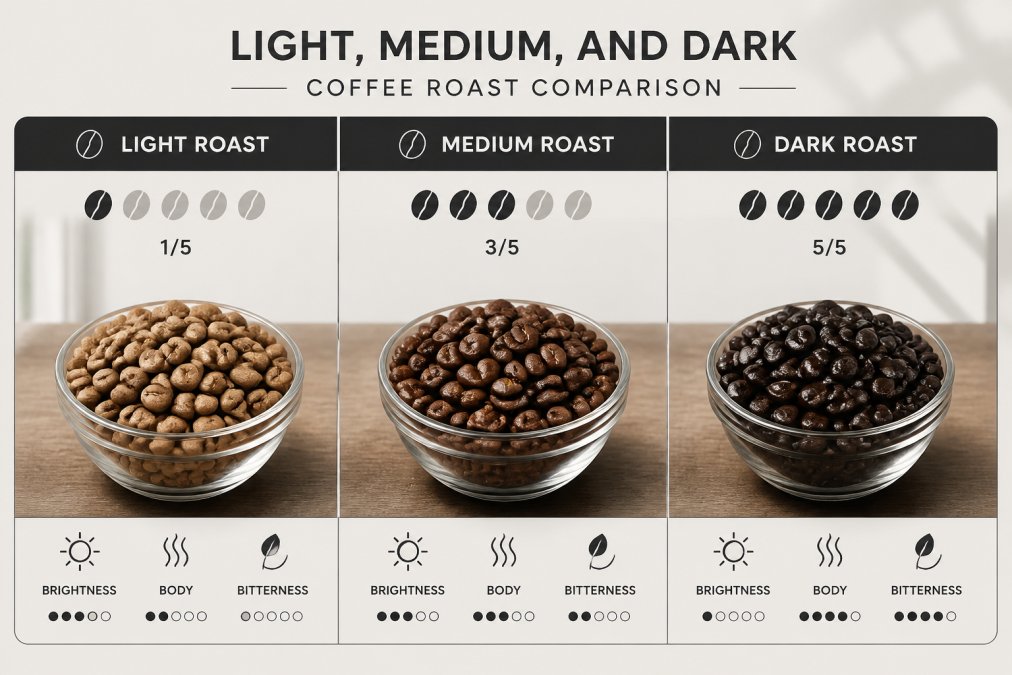
Flavor and Acidity by Roast Level
Light roasts keep more of the bean's natural character: citric acid, fruit, and floral notes, with a tangy quality some love and others find sharp.
Medium roasts sit in the middle. The Maillard reaction and caramelization develop sweetness and body while acidity softens. This is the most forgiving roast for most brew methods.
Dark roasts push past second crack. Sugars caramelize hard, oils rise to the surface, and origin flavors fade behind roast character: smoky, bittersweet, sometimes woody.
| Roast Level | Flavor Profile | Acidity | Best For |
|---|---|---|---|
| Light | Bright, fruity, floral | High | Pour-over, cold brew |
| Medium | Balanced, sweet, nutty | Medium | Drip, espresso |
| Dark | Bold, smoky, bittersweet | Low | Espresso, milk drinks |
Caffeine Content: Myth vs. Reality
The belief that dark roast has more caffeine is wrong. Caffeine is stable in the green bean; roasting does not create it. Roasting changes the bean's mass, structure, and how easily water reaches the caffeine inside.
Mass loss, not caffeine gain. A green bean loses roughly 12 to 20 percent of its weight during roasting, mostly water and carbon dioxide, while caffeine survives almost entirely intact. So by weight, a dark roast contains slightly less caffeine per gram, a small difference, usually a few percent, but opposite to the myth.
Why dark roast feels stronger. Darker beans are more porous: cell walls have fractured, oils have migrated to the surface, and water penetrates faster, so a dark roast gives up caffeine more quickly. A 25-second dark-roast espresso can pull more caffeine than a 25-second light-roast one. Solubility and extraction speed, not caffeine content, drive the perceived kick.
The variable that actually matters: dose. Caffeine in your cup is driven mostly by how much ground coffee you use and how much you extract.
The Health Angle Most Roast Guides Skip: Antioxidants and Chlorogenic Acid
Green coffee beans are rich in chlorogenic acids, a family of polyphenol antioxidants, and roasting degrades them. The darker you roast, the more you destroy.
How to Choose Coffee Roast Levels for Your Brew Method
Match the roast to the brew method, not the other way around. Espresso rewards dark and medium roasts, pour-over rewards light and medium, and cold brew works with almost anything but shines with light roasts. Learning how to choose coffee roast levels is mostly about extraction, how fast water pulls solubles out of a bean, and whether your brewer gives you enough control to compensate.
Why Roast Level Changes Your Brew, Not Just Your Flavor
Roast level changes two physical properties that directly affect brewing: density and solubility.
Matching Roast to Espresso, Pour-Over, and Cold Brew
Espresso. Espresso needs a roast that stands up to pressure and, often, milk. Medium to dark roasts give you the body and low acidity that keep a shot from tasting scalded or flat. Start with a 1:2 ratio, 18 grams in, about 36 grams out, in 25 to 30 seconds; grind finer if the shot runs faster than 25 seconds, coarser past 30.
- Espresso: medium to dark, fine grind, 1:2 ratio, 25-30 second shot
- Pour-over: light to medium, medium grind, 1:16 ratio, 3-4 minute brew
- Cold brew: any roast, coarse grind, 1:5 concentrate, 12-18 hour steep
- Drip: medium, medium grind, follow your machine's ratio
A Roast-to-Brewer Cheat Sheet
If you want the short version, here is how the three roast tiers map onto the most common home brewers:
| Roast | V60 / Pour-Over | French Press | AeroPress | Espresso | Cold Brew |
|---|---|---|---|---|---|
| Light | Excellent, highlights origin | Good, needs long steep | Good, use finer grind | Difficult, needs long ratio | Very good |
| Medium | Excellent, most forgiving | Excellent | Excellent | Very good | Excellent |
| Dark | Fair, can taste flat | Good, watch steep time | Good, lower temp | Excellent | Fair, can taste ashy |
Coffee Freshness and Roast Dates: Why They Matter
Coffee starts losing aroma the day it finishes roasting, and degassing continues for days after. A bag roasted last week tastes noticeably different from one roasted last month.
Specialty Coffee Association freshness guidance
Fresh Roasted Coffee Subscription Benefits vs. Pre-Packaged Pods
Fresh roasted coffee subscription benefits come down to three things: freshness, variety, and control. A subscription ships coffee close to its roast date, rotates origins, and lets you dial in roast level and grind.
Here is the trade-off in plain terms:
| Factor | Fresh Roasted Subscription | Pre-Packaged Pods |
|---|---|---|
| Freshness | Days from roast | Weeks to months |
| Flavor variety | High, rotates origins | Limited to pod lineup |
| Brew control | Full (grind, dose, ratio) | None |
| Convenience | Moderate | Highest |
| Cost per cup | Varies by roast and volume | Typically lower upfront |
National Coffee Association consumer trends
Visual Identification Guide: Spotting Roast Levels at a Glance
You can identify roast level by sight. Light roasts are dry and pale brown with no surface oil, medium roasts chocolate brown and mostly dry, and dark roasts dark brown to near-black with visible surface oil.
Here is the quick visual checklist:
- Color: pale tan (light) → chocolate (medium) → near-black (dark)
- Surface oil: none (light) → slight (medium) → glossy (dark)
- Bean size: larger and denser (light) → smaller and more porous (dark)
- Smell: grassy and fruity (light) → sweet and nutty (medium) → smoky and bitter (dark)
Conclusion
Choosing between a convenience-first pod service and roast-based buying comes down to what you value more: speed or flavor control. Most drinkers find the answer is a mix, and that is where a roasted-to-order subscription earns its place.
Frequently Asked Questions
Does roast level affect the caffeine content of my coffee?
Roast level changes caffeine content less than most people think. A dark roast bean loses some mass during longer roasting, so if you measure by scoop, you may get slightly less caffeine. By weight, the difference is minimal. What matters more is how much coffee you use and your brewing method. A strong dark roast espresso can have more caffeine per serving than a light roast drip coffee.
What are the four types of coffee roasts?
The four main coffee roast levels are light, medium, medium-dark, and dark. Light roasts stop before second crack, keeping bright acidity and origin flavors. Medium roasts balance acidity and body. Medium-dark roasts bring out caramelized sweetness and deeper flavor. Dark roasts go past second crack, producing smoky, bold, and sometimes bitter notes. Each level suits different brewing methods and taste preferences.
What should I look for in a coffee subscription service?
Look for roast-to-order timing, transparent roast dates on the bag, and shipping speed. A fresh roasted coffee subscription benefits you most when beans ship within 24 to 48 hours of roasting. Check whether the service offers whole bean or ground options, single-origin or blends, and flexible delivery frequency. Also consider packaging sustainability and whether the company shares sourcing details.
How does roast date impact the flavor profile of my morning cup?
Coffee freshness and roast dates directly affect flavor. Beans peak between 4 and 14 days after roasting. Before that, they degas carbon dioxide and taste flat. After 3 to 4 weeks, oxidation dulls the flavor profile, making coffee taste woody or stale. Always check the roast date, not just a best-by date, and buy from roasters who print the actual roast day on the bag.
Is light roast or dark roast better for home brewing?
It depends on your brewing method. Light roasts work well for pour-over and drip because their bright acidity and delicate origin flavors shine with slower extraction. Dark roasts suit espresso and French press, where their bold, smoky character and lower acidity stand up to intense brewing. Medium roasts are the most versatile for any method. Try a few roast levels to find what matches your daily routine.