

How to Tell if Coffee Is Stale: 7 Freshness Tests
Table of Contents
- Why Coffee Goes Stale: Degassing and Oxidation
- Signs of Stale Coffee Beans: What to Look For
- How to Tell if Coffee Is Stale by Smell
- Taste Test: Flavor Profile of Fresh vs. Stale Coffee
- The Coffee Bloom Test: A Reliable Freshness Check
- Coffee Shelf Life After Roasting: Whole Bean vs. Ground
- How to Store Coffee Beans Properly to Prevent Staling
- What to Do With Stale Coffee: Repurpose, Don't Toss
- Frequently Asked Questions
Last Updated: September 5, 2026
Why Coffee Goes Stale: Degassing and Oxidation
Coffee staling is not a single event but a two-stage chemical decline that begins the moment the bean leaves the roaster. Understanding this timeline is the first step in knowing how to tell if coffee is stale.
Stage 1: Degassing (The First 24-72 Hours)
Immediately after roasting, coffee beans are saturated with carbon dioxide (CO2), up to two liters per kilogram of beans (sciencedirect.com). This gas is a byproduct of the Maillard reaction and caramelization that occur during roasting. In the first few days, the beans are actively "off-gassing." This is why freshly roasted coffee needs to rest; brewing it immediately results in an uneven, muddy extraction as the escaping gas disrupts the water flow. Most specialty roasters recommend a rest period of 3 to 14 days post-roast, depending on the roast profile, to allow the coffee to stabilize (sca.coffee).
Stage 2: Oxidation (The Slow Decline)
Once the majority of CO2 has escaped, oxygen begins to penetrate the bean's cellular structure. This is the primary driver of staleness. Oxygen reacts with the lipids (oils) and chlorogenic acids in the coffee, causing them to break down and turn rancid. The volatile aromatic compounds, the hundreds of chemicals responsible for floral, fruity, and sweet notes, are either oxidized into less pleasant molecules or simply evaporate. The result is a flattening of the flavor profile and the emergence of that telltale papery or cardboard taste.
The Role of Roast Level in Staling Rate
A common misconception is that all coffee stales at the same rate. In reality, the roast level dictates the speed of degradation.
- Light Roasts: These beans are denser and have less oil on the surface. They degas more slowly and retain their delicate, origin-driven flavors for a slightly longer window. However, because they are less porous, the oxidation process is more subtle, making staleness harder to detect by smell alone.
- Dark Roasts: The intense heat of a dark roast expands the bean's cellular structure, making it more porous. This means degassing happens faster, and oils migrate to the surface quickly. While a dark roast may smell intensely smoky and rich initially, those surface oils are highly susceptible to oxidation. Within a few weeks, those oils turn rancid, producing a distinctly bitter, ashy, or "old oil" flavor that masks the coffee's original character.
This chemical timeline explains why the "roast date" is non-negotiable. A bag roasted four weeks ago has already lost a significant percentage of its volatile compounds, regardless of how it was stored. The question isn't if it has staled, but how much.
Signs of Stale Coffee Beans: What to Look For
Stale coffee announces itself visually long before you take a sip. Fresh whole bean coffee has a matte, dry surface with a subtle sheen of natural oils depending on the roast level. As beans age, that surface changes dramatically.
Look for these visual indicators of aging:
- Dull, lifeless appearance: Fresh beans look slightly oily or velvety; stale beans look dusty and dry.
- Uneven oil residue: Older beans develop a sticky, blotchy oil film that signals the internal oils have migrated and oxidized.
- Cracked or flaking surfaces: Prolonged exposure to air makes the bean structure brittle.
The most reliable visual cue, however, is the roast date. If the bag lacks one, or the date is more than four weeks old, you are already fighting a losing battle. A missing roast date is the single largest red flag, since it tells you the roaster does not prioritize freshness.
How to Tell if Coffee Is Stale by Smell
The aroma test is the fastest and most accurate sensory evaluation you can perform. Freshly roasted coffee should smell vibrant, sweet, and complex, with notes that remind you of caramel, fruit, nuts, or chocolate depending on the origin. Stale coffee, by contrast, loses that aromatic intensity entirely.
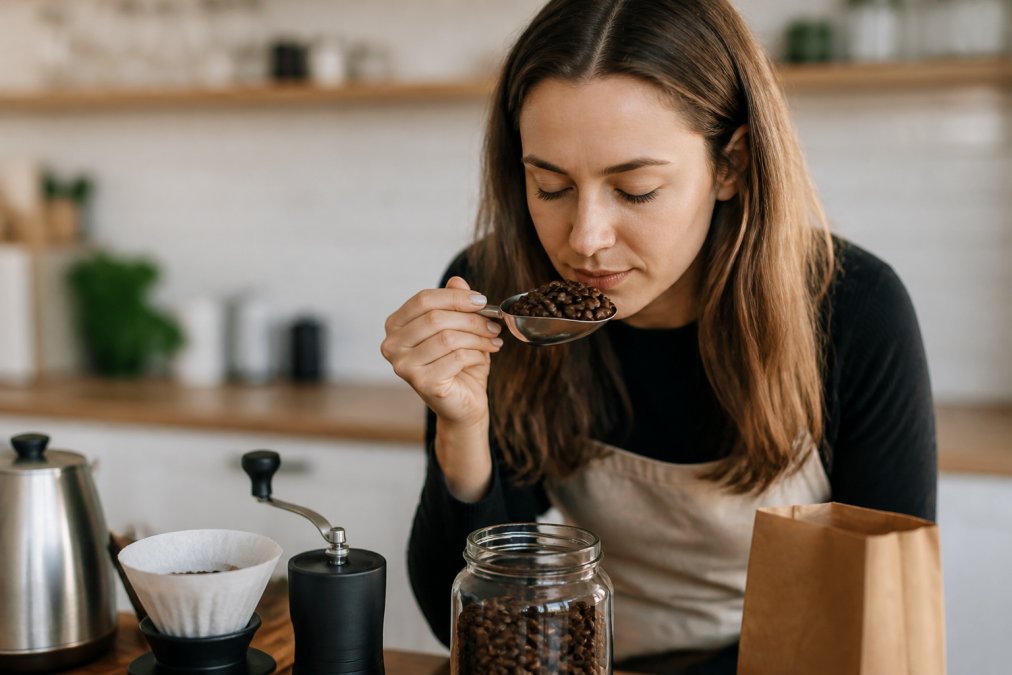
Crack a few beans in your hand or grind a small portion, then inhale deeply. What you are looking for is a loss of sweetness and the emergence of off-notes. A common mistake is confusing a darker roast's smoky character with staleness; instead, focus on whether the aroma feels hollow or muted. If the beans smell musty, like cardboard, or simply like nothing at all, they are past their prime. Trust your nose here, it is remarkably accurate at detecting the absence of the volatile compounds that make coffee enjoyable.
Taste Test: Flavor Profile of Fresh vs. Stale Coffee
Taste is the final arbiter, and the difference between fresh and stale coffee is unmistakable once you know what to listen for. Fresh coffee has brightness and acidity that cut through the cup, a lively complexity that shifts as the coffee cools. Stale coffee tastes flat, hollow, and one-dimensional, often with a papery or cardboard-like finish that lingers unpleasantly.
The most telling test is to brew a cup and let it cool slightly. As fresh coffee drops in temperature, its flavor profile unfolds, revealing new layers of sweetness and nuance. Stale coffee does none of this. It tastes dull and bitter from the first sip to the last, with no evolution and no vibrancy. The extraction also suffers, stale beans produce a weak, thin crema and a brew that lacks body, regardless of how you grind or brew it.
The Coffee Bloom Test: A Reliable Freshness Check
The bloom test is a practical, reliable way to gauge bean freshness before you commit to a full brew. When hot water first hits freshly ground coffee, the trapped carbon dioxide escapes, causing the grounds to bubble and expand visibly. This reaction is the degassing process in action, and it is a direct indicator of how recently the beans were roasted.
Here is how to perform the coffee bloom test:
- Grind your beans and place them in your brewer.
- Pour just enough hot water (around 200°F) to saturate the grounds (nist.gov).
- Watch for 30 seconds.
A vigorous, puffy bloom indicates fresh coffee with high carbon dioxide content. A weak, flat bloom, or none at all, means the beans have degassed significantly and are likely stale. While very dark roasts bloom less than light roasts, a total absence of bloom is a clear warning sign. This test is a staple in our roasting process at Black Cat Coffee Co., where we measure bloom behavior to ensure every batch meets our freshness standards.
Coffee Shelf Life After Roasting: Whole Bean vs. Ground
Coffee shelf life after roasting depends almost entirely on two factors: whether the beans are whole or ground, and how they are stored. Whole bean coffee retains its optimal flavor for roughly two to four weeks after the roast date. Ground coffee, with its vastly increased surface area, stales much faster, often within days, as oxidation accelerates dramatically.
| Coffee Form | Peak Freshness Window | Primary Staling Risk |
|---|---|---|
| Whole Bean | 2-4 weeks after roast date | Slow oxidation, degassing |
| Ground Coffee | 3-7 days after grinding | Rapid oxidation, aroma loss |
| Vacuum Sealed | Up to several months | Only after opening |
This is why buying whole beans and grinding immediately before brewing is the single most effective habit for extending freshness. It is also why we roast to order at Black Cat Coffee Co., so the shelf life clock starts when the beans reach you, not when they left a warehouse months prior. The roast date is your best guide, treat anything beyond four weeks for whole beans with suspicion.
How to Store Coffee Beans Properly to Prevent Staling
Storing coffee properly is about controlling four enemies: oxygen, moisture, heat, and light. An airtight container in a cool, dark cabinet is the gold standard. Avoid clear jars on sunny counters, transparent containers expose beans to light that accelerates degradation.
The most contentious question is refrigeration. The short answer is to avoid it. The moisture in a refrigerator causes beans to absorb odors and introduces humidity that ruins flavor. The freezer can work for long-term storage of vacuum-sealed bags, but only if you never repeatedly open and close the container, as the temperature swings cause condensation. For daily use, a simple ceramic or opaque metal canister with a one-way valve, stored away from the stove, will preserve freshness far better than any high-tech solution. The goal is to slow the oxidation process, and a stable, cool, dry environment achieves that.
What to Do With Stale Coffee: Repurpose, Don't Toss
Once beans have lost their volatile aromatics, no brewing technique will resurrect them. But that doesn't mean the bag is destined for the landfill. Stale coffee, both grounds and whole beans, has a surprising number of high-utility second lives. This is the zero-waste playbook most freshness guides skip.
In the Garden: More Than Just Compost
Stale grounds are a slow-release source of nitrogen, a key nutrient for leafy growth. But their utility goes beyond the compost bin.
- Direct Soil Amendment: Work the used or stale grounds directly into the top few inches of soil around acid-loving plants like azaleas, blueberries, and rhododendrons. The grounds slightly acidify the soil as they break down. A common pattern is to mix grounds with dry leaves or grass clippings in a 1:3 ratio to prevent the grounds from forming a water-repelling crust.
- Worm Bin Booster: Red wiggler worms thrive on coffee grounds. Adding a cup of stale grounds to a worm bin every week provides grit for their digestion and increases the nutrient density of the resulting castings.
- Natural Pest Deterrent: Sprinkling dry, stale grounds in a ring around garden beds can help deter slugs and snails. The abrasive texture is a physical barrier, not a chemical poison.
Around the House: Absorbing Odors and Scrubbing
The most common household use is as a deodorizer, but the application matters.
- Refrigerator Deodorizer: Dry the grounds completely on a baking sheet in a low oven (around 200°F) for 20 minutes. Place the fully dry grounds in an open container in the fridge. Replace every two weeks. The key is dryness; damp grounds will mold.
- Hand and Surface Scrub: The fine grit of coffee grounds makes an excellent abrasive cleaner. Mix a tablespoon of stale grounds with a drop of dish soap to scrub away baked-on food from cast iron skillets or to remove garlic and onion odors from your hands. The grounds are tough on grime but soft enough to avoid scratching most surfaces.
In the Kitchen: A Savory Flavor Booster
Stale coffee is not a beverage, but it is a legitimate cooking ingredient.
- Dry Rubs: Add finely ground stale coffee to a spice rub for beef or pork. The coffee's bitter, roasted notes add a deep, smoky complexity that complements the meat's natural flavors. Use a 1:1 ratio of coffee to smoked paprika as a starting point.
- Baking: A tablespoon of stale grounds can be added to chocolate cake or brownie batter to intensify the chocolate flavor without making it taste like coffee. The bitterness rounds out the sweetness, a technique used in many professional pastry kitchens.
The Final Option: Cold Brew (With Caveats)
If you must brew it, cold brew is the most forgiving method for stale beans. The long, cold extraction process is less efficient at pulling out the bitter, oxidized compounds that hot water extracts. The result will be a smoother, less acidic cup, but it will still lack the complexity of fresh coffee. Use a coarser grind and a longer steep time (18-24 hours) to maximize what little flavor remains.
Ultimately, the best way to deal with stale coffee is to prevent it from happening in the first place. But when it does, these methods ensure that the beans' journey doesn't end in a trash bag.
Frequently Asked Questions
Is it safe to drink stale coffee?
Yes, drinking stale coffee is safe. It won't make you sick, but it will taste flat, dull, and possibly papery or cardboard-like. The aromatic oils that give coffee its vibrant flavor degrade over time through oxidation. You can still brew and drink it, but you won't get the complex flavor profile the roaster intended. If you notice a rancid or musty smell, that's a sign the oils have gone off, and you should toss those beans rather than brew them.
How can you tell if ground coffee has gone bad?
Ground coffee stales faster than whole bean because more surface area is exposed to oxygen. Look for a loss of aroma, a flat or hollow smell, and a dull, bitter taste. The coffee bloom test also works for grounds: pour hot water over them and watch for bubbling. Fresh grounds will release carbon dioxide and bubble vigorously; stale grounds will barely react. A rancid or musty odor means the coffee has truly gone bad.
Does the roast date matter for coffee freshness?
The roast date matters more than the best-by date. Coffee is freshest within 2 to 4 weeks after roasting, which is when you get the full aroma, brightness, and complexity. After that, oxidation takes over and flavor fades. Beans need a few days to degas after roasting, so brew them no earlier than 3 days post-roast. Always check for a roast date on the bag; if you only see a best-by date, the coffee may already be stale.
How long does coffee stay fresh after opening the bag?
Whole bean coffee stays fresh for about 2 to 4 weeks after the roast date if stored properly. Once you open the bag, the clock speeds up because oxygen and moisture start working on the beans. Ground coffee loses its peak flavor within 1 to 2 weeks of opening. To maximize freshness, buy whole beans, grind only what you need, and store the rest in an airtight container away from light, heat, and moisture. Do not refrigerate or freeze beans you use daily.