

How to Compost Coffee Pods Properly: A 2026 Guide
Table of Contents
- Why Composting Coffee Pods Properly Matters in 2026
- Certified Compostable Coffee Pods: How to Spot the Real Thing
- How to Dispose of Plastic Coffee Pods Without Sending Them to Landfill
- Step-by-Step: Composting Coffee Pods at Home
- The Benefits of Using Reusable Coffee Pods
- Common Mistakes That Send Coffee Pods to the Landfill
- Conclusion
- Frequently Asked Questions
Last Updated: September 17, 2026
Why Composting Coffee Pods Properly Matters in 2026
Most coffee drinkers who want to compost coffee pods assume the pod they toss in the trash will break down eventually. It won't. A single-serve pod is a small, sealed package engineered to keep oxygen out and flavor in, and that same design keeps moisture and microbes out of the landfill. Learning how to compost coffee pods properly starts with accepting an uncomfortable fact: convenience and decomposition are working against each other, and the pod usually wins.
Certified Compostable Coffee Pods: How to Spot the Real Thing
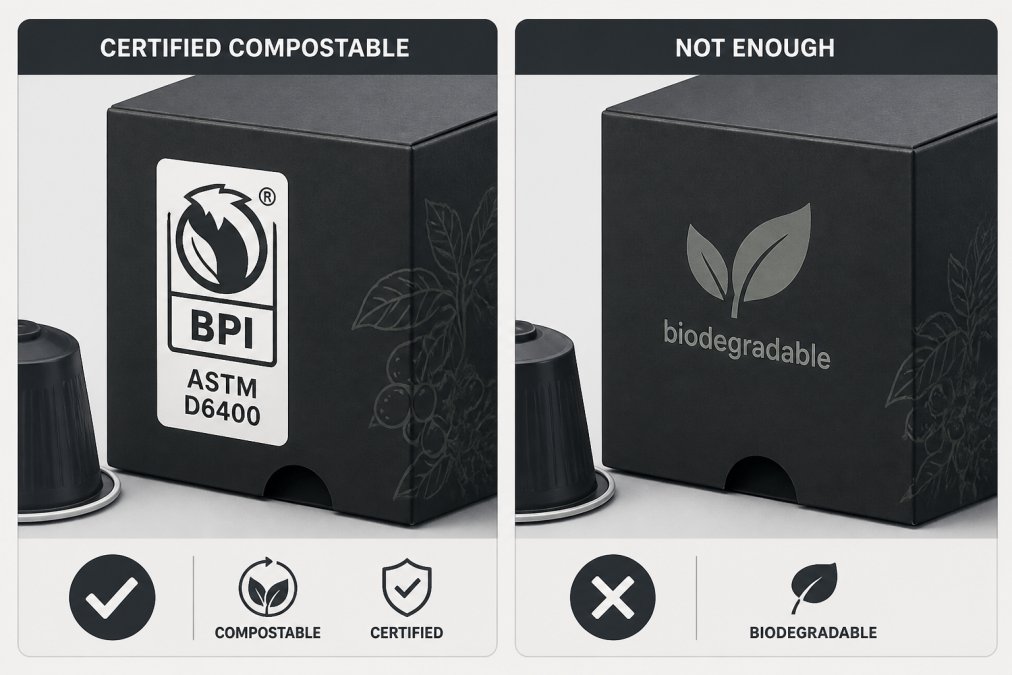
Certified compostable coffee pods carry a third-party certification mark that verifies the material breaks down within a defined timeframe under specific conditions. Without that mark, "compostable" is a marketing word with no standard behind it. The problem is that the marks are small, the terminology is slippery, and several lookalike labels are designed to sound like certifications without being one.
The Marks That Actually Mean Something
In the United States, two certification marks carry real weight:
- BPI (Biodegradable Products Institute) logo, a stylized circular mark, usually printed in green or black. BPI certification confirms the product meets ASTM D6400 (for plastic films and bags) or ASTM D6868 (for items with a plastic coating on paper or fiber, which is how most pod shells are classified). Both standards require the material to disintegrate and biodegrade within a set window under industrial composting conditions, leave no toxic residue, and pass a plant-growth test.
- CMA (Compost Manufacturing Alliance) mark, a smaller, less common certification that verifies the pod will break down in real commercial facilities, not just in a lab. CMA's testing is field-based, which is why some commercial composters prefer it over BPI alone.
Where to Look on the Package
The certification mark is almost always printed on the box, not the pod itself. Pods are too small to carry a legible mark, and the foil or paper lid rarely has room. If you've already thrown the box away, check the manufacturer's website for a certification statement, legitimate brands list the standard number (ASTM D6400 or D6868) and the certifying body.
Why 'Recyclable' and 'Biodegradable' Labels Are Not Enough
A "recyclable" pod typically means the plastic shell can theoretically be processed, but the small size and coffee residue often cause it to fall through sorting equipment at municipal waste facilities. "Biodegradable" has no enforceable US standard and can describe a product that takes years to break down. Neither term tells you whether the material will actually decompose in a home compost bin or a commercial facility.
A Quick Visual Checklist
When you're standing in the coffee aisle, run through this in order:
- Is there a BPI or CMA mark on the box? If no, stop, it's not certified.
- Does the mark say "home compostable" or just "compostable"? Only the former belongs in a backyard bin.
- Is the standard number printed (ASTM D6400 or D6868)? If yes, the claim is verifiable.
- Does the box also say "recyclable"? That's a separate claim about the shell, not the whole pod, don't let it substitute for a compost certification.
BPI's searchable list of certified products
How to Dispose of Plastic Coffee Pods Without Sending Them to Landfill
Plastic and aluminum pods can often be diverted from landfill, but they require manual disassembly because automated sorting rarely recovers items this small. The key is separating the three components: grounds, filter paper, and the shell or casing. What most guides skip is why the system fails these pods and what to do about it.
Why Small Plastics Slip Through
Municipal recycling facilities (MRFs) sort material by size, shape, and density. Most use screens with openings sized to let small items fall through to the residue stream, anything under roughly 2 inches is at high risk of being screened out and sent to landfill. A coffee pod is about 1.5 inches across, which puts it squarely in that loss zone.
Step-by-Step: Separating Pods for Recycling and Compost
- Let the pod cool completely, then peel back the foil or paper lid.
- Tip the spent coffee grounds into a bowl or directly into your compost bin. Grounds are nitrogen-rich and compost quickly.
- Lift out the filter paper if your pod has one. Most paper filters are compostable; plastic mesh liners are not.
- Rinse the empty plastic shell to remove residue.
- Check whether your local recycling stream accepts small rigid plastics. If it does not, look for a pod-specific take-back program.
That final step is where most recycling efforts stall. Small plastic items frequently fall through the gaps at municipal waste facilities, so a take-back program run by the pod manufacturer is often the only reliable route.
| Pod Component | Best Disposal Method | Why |
|---|---|---|
| Coffee grounds | Compost bin or garden | Nitrogen-rich organic matter |
| Paper filter | Compost | Breaks down quickly |
| Plastic mesh liner | Trash | Not compostable |
| Plastic shell | Take-back program | Too small for curbside sorting |
| Aluminum casing | Scrap metal recycling | High recovery value |
How Take-Back Programs Actually Work
A pod take-back program is a manufacturer-run collection system: you save used pods, mail them in or drop them at a participating location, and the company separates the components at scale. The economics work because the manufacturer controls the material stream and can send grounds to commercial composters and shells to recyclers in bulk. Nespresso's program, for example, uses prepaid mail-back bags and drop-off points at partner retailers; Keurig's Grounds to Grow On program has historically routed pods through commercial composting partners.
Finding a Commercial Composting Facility Near You
- Search your state's environmental or solid waste agency website for a list of permitted composting facilities.
- Check the US Composting Council's facility locator, which maps commercial composters by state.
- Call the facility directly and ask two questions: Do you accept compostable packaging? and Do you accept coffee pods specifically? Many facilities accept food scraps but reject packaging because they can't verify certification at the gate.
- If your city has a curbside organics program, check whether it accepts certified compostable packaging, some do, many don't.
US Composting Council's find-a-composter tool
Step-by-Step: Composting Coffee Pods at Home
Home composting works best for pods explicitly certified for backyard bins. The process itself is simple, but balancing the pile is what separates a working compost bin from a smelly, stalled one.
- Confirm your pod is certified home-compostable, not industrial-only.
- Empty the grounds into your bin or pile. Coffee grounds count as green, nitrogen-rich material.
- Break or tear the pod shell into smaller pieces to speed up decomposition.
- Add a roughly equal volume of brown, carbon-rich material such as dry leaves, cardboard, or shredded paper.
- Turn the pile every week or two to introduce aeration and keep decomposition active.
- Keep the pile as damp as a wrung-out sponge. Too dry stalls it; too wet turns it anaerobic and foul.
- Expect grounds to break down in weeks, while plant-fiber shells can take several months.
The Benefits of Using Reusable Coffee Pods
Reusable coffee pods sidestep the sorting problem entirely. You fill a stainless steel or durable plastic capsule with your own ground coffee, brew, then rinse and refill it. There is no shell to disassemble, no certification to verify, and no question about where the waste goes because there is none beyond the grounds themselves.
Common Mistakes That Send Coffee Pods to the Landfill
Even careful households lose pods to the trash through a handful of recurring errors. Knowing them in advance saves a lot of wasted effort.
- Assuming all "compostable" pods work in a backyard bin. Industrial-only pods need commercial facility conditions.
- Tossing whole pods into the compost. The sealed shell slows decomposition dramatically; open it first.
- Skipping the brown-material balance. All-grounds piles compact and turn anaerobic.
- Rinsing plastic pods but leaving them loose in curbside recycling. Small items get lost in sorting.
- Trusting front-of-box claims without checking for a BPI or CMA mark.
- Forgetting that filter paper and plastic mesh liners are different materials with different disposal paths.
Conclusion
Getting coffee pod disposal right comes down to one question: does this specific pod break down where I can actually send it? Answer that honestly, sort the components, and balance your compost pile, and very little ends up in landfill. Black Cat Coffee Co. roasts to order and offers coffee pods alongside single-origin beans and premium teas, so you can match your brewing habit to a disposal method that works.
Frequently Asked Questions
Can Keurig pods be composted?
Only if the pod is labeled certified compostable. Standard Keurig K-Cups use a plastic cup with an aluminum lid and filter paper, which do not break down in home compost bins. You can tear the pod apart, compost the coffee grounds and paper filter, and check whether your local recycling program accepts the plastic cup. Black Cat Coffee Co. offers coffee pods alongside single-origin beans and premium teas.
How do I know if my coffee pod is certified compostable?
Look for a certification logo printed on the box or the pod itself, such as the BPI Compostable logo. These mean the pod has passed testing for breaking down in industrial composting conditions within a set timeframe. If the packaging only says 'biodegradable' or 'eco-friendly' without a certification mark, treat it as conventional plastic and dispose of it accordingly.
Can you add too much coffee grounds to your compost?
Yes. Coffee grounds are nitrogen-rich, and piling in too many without balancing carbon-rich brown materials like dry leaves, cardboard, or shredded paper can make your compost pile acidic and slow decomposition. Aim for roughly one part coffee grounds to two or three parts brown materials by volume, and turn the pile regularly to keep aeration up. A balanced mix keeps the pile hot and breaks down faster.
Are compostable coffee pods healthier?
Compostable pods are not healthier for you in terms of what ends up in your cup. The coffee inside is the same. The benefit is environmental: certified compostable pods break down in industrial composting facilities instead of sitting in a landfill for decades. If you care about reducing plastic waste and your local waste management program accepts compostable material, they are a better disposal choice.