

How to Brew Single Origin Coffee: A Complete Guide
Table of Contents
- Why Single Origin Coffee Demands Different Brewing
- Understanding Single Origin vs. Blends
- Coffee Grind Size Chart and Selection
- Water Temperature for Coffee Brewing
- Pour Over Coffee Ratio and Measurement
- Step-by-Step Brewing Methods for Single Origin
- Troubleshooting Extraction Issues
- Identifying Flavor Profiles and Tasting Notes
- Frequently Asked Questions
Last Updated: September 20, 2026
Why Single Origin Coffee Demands Different Brewing
Single origin coffee isn't just a label. It's a commitment to flavor. When you brew single origin, you're working with beans that express a specific terroir, altitude, and processing method. That means your brewing approach needs to match the bean's characteristics, not fight against them.
Blended coffees are engineered for consistency. They're forgiving. Single origin beans demand precision. The difference shows up in your cup immediately. A grind that's slightly too coarse or water that's a few degrees too cool will flatten the flavor profile you paid for.
At Black Cat Coffee Co., we source single origin beans from trusted farms and roast them to order. The result is maximum freshness and clarity in every cup. But freshness alone isn't enough. Your brewing method determines whether those origin characteristics shine or disappear.
Here's what changes: extraction timing, water temperature, agitation patterns, and brew ratios all need adjustment based on the specific bean. Understanding why matters more than following a generic recipe.
Understanding Single Origin vs. Blends
Single origin coffee comes from one farm, region, or country. Blends combine beans from multiple sources. That single source of origin means the flavor profile is consistent, traceable, and unique to that place.
Blends are designed to balance flavors. A roaster mixes beans to create smoothness, reduce acidity, or add body. Single origin beans stand alone. They showcase what that specific terroir produces. An Ethiopian Yirgacheffe tastes nothing like a Colombian Geisha, and that's the point.
When you brew single origin, you're not balancing flavors. You're revealing them. That requires a different approach to:
- Grind size consistency
- Water temperature precision
- Brew time management
- Agitation technique
Blends forgive rough technique. Single origin beans don't. A slightly inconsistent grind in a blend? You won't notice. The same grind in a single origin? The under-extracted particles will taste sour, and the over-extracted ones will taste bitter.
This is where most home brewers struggle. They apply blend-brewing techniques to single origin beans and wonder why the coffee tastes flat or harsh.
Coffee Grind Size Chart and Selection
Grind size determines how fast water passes through the coffee grounds. Finer grinds slow water down. Coarser grinds speed it up. The right size extracts the right amount of flavor.
Single origin beans need consistency more than blends do. An inconsistent grind means some particles extract too fast and others too slow. You get sour notes mixed with bitter ones.
Here's how grind size affects extraction:
| Grind Size | Brew Method | Extraction Speed | Best For |
|---|---|---|---|
| Extra Fine | Turkish | Very Slow | High-acidity origins |
| Fine | Espresso | Slow | Concentrated shots |
| Medium-Fine | Pour Over | Moderate | Most single origins |
| Medium | Drip Machine | Moderate | Balanced brewing |
| Medium-Coarse | French Press | Fast | Low-acidity origins |
| Coarse | Cold Brew | Very Fast | Long immersion |
The grind size you choose changes how the origin characteristics come through. A finer grind extracts more acidity and clarity. A coarser grind emphasizes body and sweetness.
For single origin brewing, consistency matters more than perfection. Use a burr grinder, not a blade grinder. Burr grinders produce uniform particles. Blade grinders create dust mixed with chunks. Dust over-extracts. Chunks under-extract. You get muddy, unbalanced coffee.
Water Temperature for Coffee Brewing
Water temperature controls extraction speed. Hotter water extracts faster. Cooler water extracts slower. Single origin beans need the right temperature to express their flavor profile.
Most guides recommend 195-205°F. That's a starting point, not a rule. The right temperature depends on the bean's origin and roast level.
Light roasts need hotter water. They're denser and require more heat to extract properly. A light roast Ethiopian at 195°F might taste sour and thin. The same bean at 205°F opens up with clarity and sweetness.
Dark roasts need cooler water. They're more porous and extract faster. A dark roast at 205°F might taste burnt and harsh. Drop to 195°F and the body becomes smooth.
Here's the practical approach:
- Light roasts: 200-205°F
- Medium roasts: 197-202°F
- Dark roasts: 190-200°F
Temperature precision matters. A 5-degree difference changes extraction noticeably. Use a thermometer. Don't guess. The clarity you're paying for in single origin beans depends on hitting the right temperature.
Water also matters. Tap water with minerals (total dissolved solids) affects extraction. Distilled water extracts too fast and tastes thin. Filtered water with light mineralization is ideal. If your tap water is very hard, consider a simple filter pitcher.
Pour Over Coffee Ratio and Measurement
The brew ratio is the weight of coffee to water. Getting this right is the foundation of consistent extraction.
Most guides use 1:16 or 1:17 ratios. That means 1 gram of coffee to 16-17 grams of water. This ratio works for most single origins. But some beans need adjustment.
Here's how to think about it:
- 1:15 ratio (stronger, more concentrated), Use for light roasts or when you want clarity to dominate
- 1:16 ratio (standard), Works for most medium roasts and balanced brewing
- 1:17 ratio (lighter, more delicate), Use for dark roasts or when you want smoothness
Start with 1:16. Measure by weight, not volume. A scale takes the guesswork out. If the coffee tastes under-extracted (sour, thin), move to 1:15. If it tastes over-extracted (bitter, harsh), move to 1:17.
Black Cat Coffee Co. recommends using a digital scale for precision. Measure your beans, grind them, then measure your water. This removes variables and gives you repeatable results.
A practical example: 25 grams of beans to 400 grams of water is a 1:16 ratio. Brew time should be 3-4 minutes for pour over. If you're closer to 2 minutes, your grind is too coarse.
Step-by-Step Brewing Methods for Single Origin
Manual Brew Techniques
Manual brewing gives you control. You decide water temperature, pour speed, agitation, and timing. Single origin beans reward this attention.
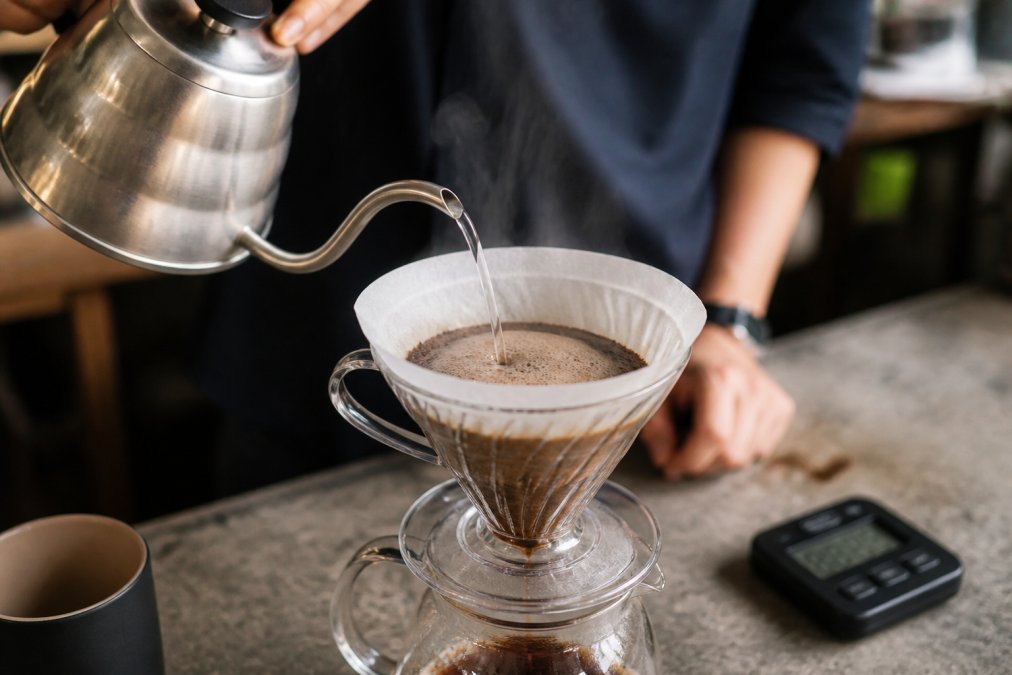
- Heat water to your target temperature (195-205°F depending on roast level)
- Grind beans to medium-fine consistency (consistency matters more than exact size)
- Place filter in dripper and rinse with hot water (removes paper taste)
- Add ground coffee and create a small well in the center
- Pour just enough water to saturate grounds (the bloom phase), about 50 grams of water for 25 grams of coffee
- Wait 30-45 seconds (this allows CO2 to escape and improves extraction)
- Pour water slowly in circular motions, keeping water level consistent
- Total brew time should be 3-4 minutes
- Stop pouring when you reach your target water weight
Immersion vs. Percolation
These are two fundamentally different extraction methods. Understanding which one suits your bean matters.
Here's how to choose:
- Want to taste origin characteristics clearly? Use percolation (pour over, drip)
- Want a smooth, body-forward cup? Use immersion (French press, cold brew)
Troubleshooting Extraction Issues
-
Grind is too coarse
-
Water temperature is too cool
-
Brew time is too short
-
Pour speed is too fast
-
Grind is too fine
-
Water temperature is too hot
-
Brew time is too long
-
Pour speed is too slow
Here's a troubleshooting flow:
If your coffee tastes sour → your grind is probably too coarse. Make it finer and try again.
Identifying Flavor Profiles and Tasting Notes
Flavor profiles describe what you taste in the cup. Tasting notes are the specific flavors: berry, chocolate, floral, nutty. Learning to identify these transforms how you experience coffee.
How to taste coffee properly:
- Smell the dry grounds (aroma tells you what's coming)
- Smell the brewed coffee (aroma changes as it cools)
- Sip while it's still hot (heat brings out certain flavors)
- Sip again as it cools (different flavors emerge as temperature drops)
- Note what you taste at each stage
Frequently Asked Questions
What is the best brewing method for single origin coffee?
Pour-over and French press are the two most popular methods for single origin coffee. Pour-over (using percolation) gives you precise control over water temperature, brew time, and extraction, making it ideal for highlighting the origin characteristics and tasting notes of single-origin beans. French press (immersion brewing) produces a fuller body and brings out different flavor dimensions. The best method depends on your equipment and preference, but pour-over is recommended for first-time single-origin brewers because it allows you to adjust variables easily if extraction issues arise.
How does grind size affect the taste of single origin beans?
Grind size directly controls how quickly water extracts flavor compounds from the coffee. Finer grinds increase surface area and slow water flow, leading to longer contact time and stronger extraction. Coarser grinds speed up water flow and reduce extraction. For single origin, proper grind size is critical: too fine causes over-extraction (bitter, harsh flavor), while too coarse causes under-extraction (sour, thin taste). Use a burr grinder for consistency, and adjust grind size based on your brewing method and the roast level of your beans.
What water temperature should I use to brew single origin coffee?
The ideal water temperature for brewing single origin coffee is between 195°F and 205°F. Water that is too hot (above 205°F) over-extracts and creates bitter, burnt flavors, while water below 195°F under-extracts and produces sour, thin coffee. For lighter roasts, use water closer to 205°F to fully develop the bean's origin characteristics. For darker roasts, aim for 195-200°F to avoid excessive extraction. Use a thermometer or an electric kettle with temperature control to maintain consistency across brews.
How do I know if my single origin coffee is properly extracted?
Properly extracted single origin coffee has clarity, balanced acidity, and distinct tasting notes that reflect the bean's origin. If your brew tastes sour or thin, you have under-extraction. If it tastes bitter or harsh, you have over-extraction. The brew ratio, grind size, water temperature, and brew time all affect extraction. A general starting point is 1:16 ratio (1 gram coffee to 16 grams water), but adjust based on your tasting results. If you're experiencing extraction issues, adjust one variable at a time and taste the difference.