

Compostable Coffee Pods vs Plastic: The 2026 Guide
Table of Contents
- Compostable vs Plastic Pods: The Short Answer
- Side-by-Side Comparison: Compostable Coffee Pods vs Plastic
- Environmental Impact: Waste, Carbon, and Circularity
- Health Concerns: Chemical Leaching and Microplastics
- How to Dispose of Coffee Pods Correctly
- BPI Certified Compostable Coffee Pods: What That Label Means
- Compostable Coffee Pods for Keurig: Finding a Compatible Fit
- Which Pod Should You Choose?
- Frequently Asked Questions
Last Updated: September 7, 2026
The coffee pod debate usually gets framed as a simple choice: plastic pods are convenient but wasteful, while compostable coffee pods are the responsible upgrade. The reality is messier. A compostable pod only delivers its environmental benefit if it actually reaches a facility capable of breaking it down, and most home compost bins never get hot enough to do the job.
This guide compares compostable coffee pods vs plastic pods across waste impact, health concerns, cost, and day-to-day usability.
Compostable vs Plastic Pods: The Short Answer
Compostable coffee pods win on environmental impact, but only when disposed of correctly. Plastic pods are recyclable in theory yet rarely recycled in practice, while compostable pods require access to industrial composting facilities to break down as intended.
If your city or workplace offers commercial composting pickup, compostable pods are the clear winner for diverting waste. If everything goes into a standard trash bin regardless, the environmental difference narrows considerably, though compostable pods still avoid the microplastic shedding associated with heated plastic.
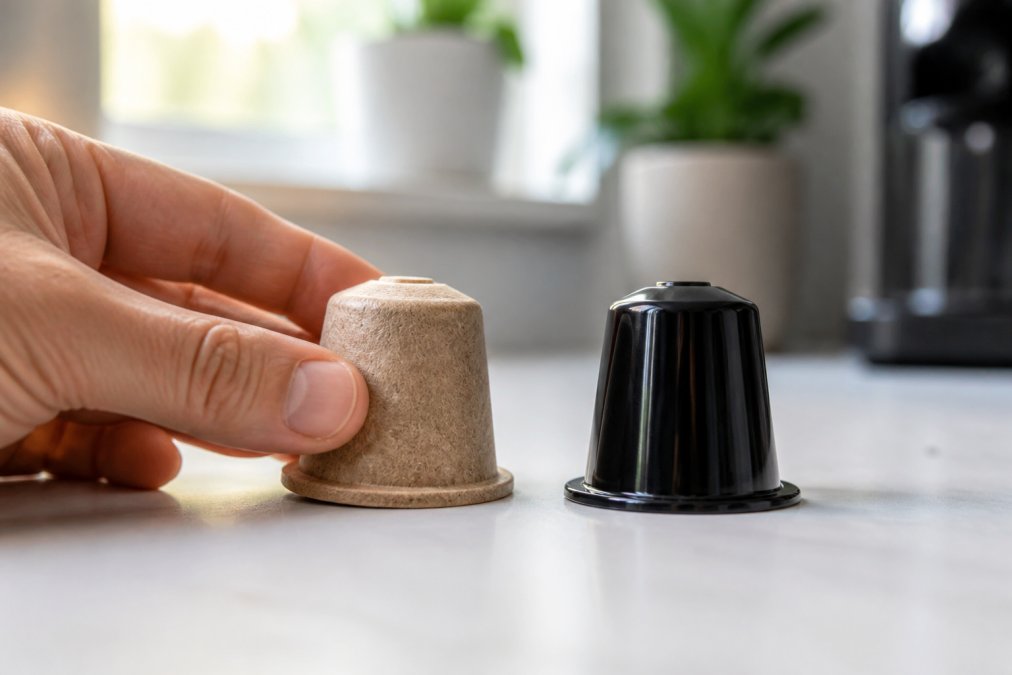
A common mistake is assuming "compostable" means you can toss the pod into your backyard bin and forget it. Most certified compostable pods require sustained temperatures above 130°F to break down, conditions found only in commercial facilities.
Side-by-Side Comparison: Compostable Coffee Pods vs Plastic
| Feature | Compostable Pods | Plastic Pods |
|---|---|---|
| Material Source | Plant-based (PLA, cornstarch) | Petroleum-based polymers |
| Breakdown Method | Industrial composting | Recycling or landfill |
| Home Compostable | Select brands only | Never |
| Microplastic Risk | Minimal | Present with heat |
| BPA Concern | Typically BPA-free | Varies by brand |
| Machine Compatibility | Keurig, Nespresso options | Universal |
| Typical Price Point | Higher | Lower |
Environmental Impact: Waste, Carbon, and Circularity
Plastic pods create a material circularity problem. A single-serve plastic pod combines plastic, aluminum, and coffee grounds into one unit that is difficult to separate, which is why so much of it enters the municipal waste stream. Many brands advertise recyclable pods, but the consumer must peel, empty, and rinse each component before recycling, a process most skip.
Compostable pods address this by using bioplastic materials like polylactic acid (PLA) derived from cornstarch. When processed in an industrial composting facility, these pods break down into organic matter that can enrich soil rather than sit in a landfill. The catch is access. The EPA's guide on composting at home and in the community notes that commercial composting infrastructure remains limited compared to recycling and landfill systems, meaning many compostable pods still end up in the trash.
The carbon footprint comparison is not one-sided either. Manufacturing bioplastics requires energy-intensive processing of agricultural crops, and critics point out that PLA production competes with food systems for land. Still, compostable materials represent a more circular option than virgin plastic.
Health Concerns: Chemical Leaching and Microplastics
The health argument for compostable pods centers on what happens when hot water meets plastic. Heating plastic can accelerate chemical leaching, and some studies have raised concerns about compounds that may migrate into your coffee. Compostable pods made from plant materials largely sidestep this issue, and most are marketed as free from BPA and microplastics.
That said, not all plastic pods are created equal. Many manufacturers now produce BPA-free pods, and regulatory oversight from the U.S. Food and Drug Administration on food contact substances helps ensure materials meet safety standards for food contact. The practical difference may be small for occasional use but more meaningful for daily drinkers who brew multiple cups.
Coffee brewers do not inherently filter microplastics from the brewing process, so any plastic degradation that occurs during brewing ends up in your cup. Compostable pods eliminate this exposure pathway entirely.
How to Dispose of Coffee Pods Correctly
Disposal is the single factor that determines whether your pod choice actually helps the environment. Knowing how to dispose of coffee pods correctly starts with reading the label, because compostable and recyclable require completely different handling.
Decoding the Certification Logos
Before you toss a pod in any bin, identify which certification it carries. These labels are not interchangeable, and the breakdown conditions they require are drastically different.
- Industrial Compostable (BPI Certified): The Biodegradable Products Institute (BPI) mark is the most common certification in the U.S. for commercial composting. A BPI-certified pod is designed to break down in a large-scale facility where temperatures are sustained above 130°F for extended periods. If your municipal hauler does not send organic waste to such a facility, this pod will not break down in your backyard bin or a standard landfill.
- Home Compostable (TUV Austria OK Compost Home): This is a stricter certification that tests for breakdown at lower, ambient temperatures typical of a backyard pile. While less common in the U.S. market, some brands like Roar Gill carry this certification. If you see this logo, the pod is designed to decompose in a well-managed home compost system, though it still requires the right balance of moisture, oxygen, and time.
- 'Plant-Based' or 'Bio-Based' Claims: These are marketing terms, not certifications. A pod made from plant-based plastic (PLA) is not automatically compostable in any setting unless it carries a specific certification logo. Treat these claims with skepticism.
Step-by-Step Disposal by Pod Type
Once you have identified the certification, follow these specific steps to ensure the pod ends up in the right stream.
- Certified Compostable Pods (Industrial): Do not put these in your home compost. Instead, check if your city or a private service offers curbside organics collection. Many municipalities that collect food scraps and yard waste also accept certified compostable packaging. If you have access to this service, place the pod directly in your organics bin, no need to empty the grounds, as the entire unit is designed to break down together.
- Certified Home Compostable Pods: These can go directly into your backyard compost bin. To speed up breakdown, you can tear the pod open and empty the grounds, but it is not strictly necessary. Ensure your pile is turned regularly and has adequate moisture.
- Recyclable Plastic Pods: These require the most effort. You must separate the foil lid, empty the coffee grounds into your compost or trash, and rinse the plastic cup before placing it in recycling. The grounds contaminate the recycling stream if left inside, and the foil lid is typically not recyclable. If you skip these steps, the pod goes to a landfill.
- Neither Option Available: If you lack access to commercial composting or a recycling program that accepts these specific plastics, the pod goes to a landfill regardless of the material. In this scenario, the environmental benefit of a compostable pod is lost, and the practical difference between it and a plastic pod narrows significantly.
The Reality of Municipal Collection
Even consumers with access to commercial composting are often unsure if their specific hauler accepts compostable pods. Unlike plastic recycling, which has a standardized numbering system, compostable packaging acceptance varies widely by facility. Before assuming your city's organics program accepts pods, check your hauler's website for a list of accepted materials. If they do not explicitly list 'compostable packaging,' call them to confirm.
BPI Certified Compostable Coffee Pods: What That Label Means
BPI certification is the gold standard for compostable packaging in the United States. The Biodegradable Products Institute verifies that a product will break down in a commercial composting facility within a specific timeframe, rather than relying on vague marketing claims.
When you see BPI certified compostable coffee pods, it means the entire pod, including the lid and filter, has been tested and shown to disintegrate under commercial composting conditions. This matters because some brands use a partially compostable design where only the ring breaks down while other components persist.
The limitation is that BPI certification does not guarantee home compostability. A BPI-certified pod still requires the heat and microbial activity of an industrial facility. Before buying, check whether your waste hauler partners with a commercial composter; if they do not, the certification is environmentally meaningless for your specific situation.
Compostable Coffee Pods for Keurig: Finding a Compatible Fit
Finding compostable coffee pods for Keurig machines is easier than it was a few years ago, but compatibility still varies by brewer model. Most compostable pods on the market fit standard K-Cup style brewers, but the plant-based materials can behave differently under pressure and heat than their plastic counterparts. The two most common user complaints are mechanical failure and a weaker brew.
Mechanical Failure Rates in High-Pressure Brewers
A significant pain point that most guides ignore is the structural integrity of compostable pods in high-pressure machines. Keurig brewers inject hot water at high pressure into the pod chamber. Plastic pods are rigid and withstand this pressure easily. Compostable pods, especially those made from softer plant-based materials, can sometimes deform or rupture under this stress.
This is not a universal problem, but it is more common in older Keurig models that use a single entry needle. If the pod material is too flexible, the needle may tear the pod instead of making a clean puncture, causing grounds to leak. Newer Keurig models with multi-stream technology tend to handle compostable pods better because they use a different extraction method.
Check user reviews for your specific machine model before buying a full box. Look for comments that mention 'leaking,' 'jammed,' or 'brewed weak' to gauge compatibility. Buying a sample pack first is the most reliable way to avoid wasting money.
The Filter Material and Microplastic Filtration
Beyond mechanical fit, the filter material itself presents a unique health consideration. Plastic pods use a fine plastic mesh filter to hold the coffee grounds. When hot water passes through this mesh, there is a potential for microscopic plastic particles to be shed into your cup.
Compostable pods, by contrast, typically use a paper or plant-based fiber filter, which does not shed microplastics. However, the trade-off is extraction efficiency. Paper filters are more absorbent and can retain some of the coffee's natural oils, resulting in a slightly cleaner but less full-bodied cup. Some brands have addressed this with a thinner paper filter or a blend of fibers, but you may still notice a difference in mouthfeel and crema.
Verifying Fit for Your Specific Model
To avoid the guesswork, here is a practical checklist before you commit to a compostable pod brand:
- Check the Pod's Dimensions: Measure the diameter and height of a standard plastic pod you currently use. Compostable pods should match these dimensions closely. A pod that is slightly too tall may not fit under the brewer's needle.
- Look for 'Keurig Compatible' Claims: While not a guarantee, brands that explicitly state compatibility have usually tested their pods against common Keurig models.
- Read Reviews for Your Model: Search for reviews from users who mention your exact Keurig model number (e.g., K-Elite, K-Mini, K-Supreme). This is the most specific data you can get without testing the pod yourself.
- Start with a Small Sample: Never buy a month's supply of a new compostable pod brand without first testing a single box. The performance can vary significantly between brands due to differences in material thickness and filter design.
By paying attention to these mechanical and material details, you can find a compostable pod that brews reliably and avoids the microplastic exposure associated with plastic mesh filters.
Which Pod Should You Choose?
Choose compostable pods if you have access to commercial composting and want to minimize plastic exposure. Choose plastic pods if cost is your primary concern and you are realistic about disposal habits.
The decision framework comes down to three questions:
- Does your city or workplace offer commercial composting pickup?
- Are you willing to pay more per cup for a lower environmental footprint?
- Does your coffee machine brew reliably with plant-based pods?
For most home drinkers, disposal infrastructure determines the outcome. If you cannot compost commercially, the environmental benefit of compostable pods is largely theoretical, though the health benefit of avoiding heated plastic remains real.
Brands like San Francisco Bay Coffee's compostable pod lineup have made BPI-certified pods widely available at competitive prices, while others like Roar Gill's home-compostable capsules cater to Nespresso Original owners who want a solution that works without industrial infrastructure. At Black Cat Coffee Co., our approach centers on roasted-to-order freshness because flavor peaks shortly after roasting, and we offer pod options that balance convenience with responsible sourcing. Shop Coffee
Choosing between compostable and plastic pods ultimately comes down to your local waste infrastructure and how much you value avoiding plastic in your brew. The environmental case for compostable coffee pods is strong, but only when commercial composting is actually available to you.
BPI's certification standards for compostable products
Frequently Asked Questions
Are compostable coffee pods actually better for the environment?
Yes, but only if disposed of correctly. Compostable pods break down into organic matter in the right conditions, unlike plastic pods which persist for centuries. However, many compostable pods require industrial composting facilities to break down efficiently. If you toss them in a regular trash bin, they may end up in a landfill where they decompose slowly, negating much of their environmental benefit.
Can I use compostable coffee pods in my Keurig?
Yes, many compostable coffee pods are specifically designed for Keurig machines. Look for brands that state Keurig compatibility on the packaging. The pod's structure needs to withstand the brewing pressure and temperature. While most work fine, you may need to adjust your brew settings slightly for optimal extraction compared to standard plastic K-Cups.
Which coffee pods do not have microplastics?
Compostable coffee pods made from plant-based materials like PLA (polylactic acid) are designed to be free from plastic and therefore do not shed microplastics during brewing. Traditional plastic pods can release microplastics, especially when exposed to hot water. Always check the packaging for terms like 'plastic-free' and 'plant-based' to ensure you're avoiding plastic exposure.
What is the difference between biodegradable and compostable coffee pods?
The key difference is certification and time frame. Compostable pods meet strict standards (like BPI certification) that guarantee they break down into non-toxic, nutrient-rich compost within a specific period in a composting environment. Biodegradable is a broader, unregulated term that simply means something will eventually break down, but it could take an indefinite amount of time and leave behind harmful residues.
Do compostable pods affect the taste of the coffee?
No, the brewing process is the same, and the coffee itself is what determines the flavor. The filter material in compostable pods is designed to be flavor-neutral. In fact, some people find compostable pods taste better because they are often made with higher-quality, freshly roasted beans compared to mass-market plastic pods that may sit on shelves for months.