

Best Coffee Blend for French Press: Our Top Picks
Quick Summary
The best coffee blend for French press depends on taste, but medium roasts like the Breakfast Blend or House Blend give a smooth, balanced cup, while the Cowboy Blend suits those who want bold, full-bodied coffee. Choose a fresh, coarsely ground blend for the press's rich texture.
- Medium roasts like the Breakfast Blend and House Blend offer a smooth, balanced cup.
- The Cowboy Blend, a dark and medium roast, delivers cocoa, caramel and vanilla tones.
- The Latin American Blend is a medium-dark roast with nutty hints and a gentle cocoa aftertaste.
- Each featured blend is priced at $23.99 for a 12-ounce bag.
- A French press steeps coarse grounds for about four minutes before pressing.
Table of Contents
- Best Coffee Blend for French Press: Our Top Picks
- What Makes a Coffee Blend Work in a French Press
- Our Top Coffee Blends for French Press at a Glance
- Best Medium Roast Coffee for French Press
- Best Dark and Full-Bodied Blends for French Press
- Choosing a Coarse Grind: Best Coarse Ground Coffee for French Press
- Best Supermarket Coffee for French Press vs. Freshly Roasted Blends
- Choosing Your Blend and Placing Your First Order
- Frequently Asked Questions
Best Coffee Blend for French Press: Our Top Picks
Last Updated: November 14, 2026
What Makes a Coffee Blend Work in a French Press
Choosing the best coffee blend for French press starts with understanding how the brewing method works. A French press steeps coarse grounds in hot water for about four minutes, then pushes a metal mesh filter through the liquid. Because the filter lets oils and fine particles through, the blend's flavor shows up more fully in the cup than it would in a paper-filtered drip brew.
That makes blend selection important. Look for a roast that tastes balanced and full, with enough body to hold up to the press's rich texture. Medium roasts are often smooth, while dark roasts bring a bolder, bittersweet character.
Freshness matters just as much as roast level. Coffee loses aroma quickly after roasting, so a bag with a recent roast date will usually taste brighter than one that has sat on a shelf for months.
Our Top Coffee Blends for French Press at a Glance
Here is a quick look at our top picks. The featured blends are priced at $23.99 for a 12-ounce bag.
Quick Picks:
- Medium Roast: Breakfast Blend, a smooth cup
- Medium Roast: House Blend, with nutty chocolate and a clean finish
- Dark and Medium Roast: Cowboy Blend, with cocoa, caramel and vanilla tones
- Medium-Dark Roast: Latin American Blend, with nutty hints and a gentle cocoa aftertaste
| Blend | Roast | Flavor Notes | Price | Best For |
|---|---|---|---|---|
| Latin American Blend | Medium-dark | Nutty, mild fruit, cocoa | $23.99 | Rich, layered cups |
| House Blend | Medium | Nutty, sweet chocolate, mild citrus | $23.99 | Everyday balance |
| Breakfast Blend | Medium | Smooth, South American | $23.99 | Smooth morning brewing |
| Cowboy Blend | Dark and medium | Cocoa, caramel, vanilla | $23.99 | Bold, full-bodied cups |
Best Medium Roast Coffee for French Press
Medium roasts are a popular choice for a French press. They keep enough natural sweetness and acidity to stay lively, while the press's heavier body rounds out the edges.
The Breakfast Blend is a smooth, straightforward cup. It is a smooth blend of coffee from South America and roasts to a medium level.
The House Blend takes a similar roast level. Its tasting notes include nutty and sweet chocolate tones with a mild citrus finish, and it has a medium body.
Pros of medium-roast blends:
- Balanced sweetness and acidity
- Lower bitterness than darker roasts
- Easy to dial in with a standard four-minute steep
Cons:
- Less intense than dark roasts for those who prefer bold coffee
Best Dark and Full-Bodied Blends for French Press
If you like a heavier, more strong cup, a darker blend may suit you better. Dark roasts bring out deeper, roasted flavors, and the French press amplifies their body.
The Cowboy Blend combines dark and medium roasted coffee. Expect cocoa, caramel and vanilla tones.
The Latin American Blend is a medium-dark roast. It offers nutty hints, mild fruity tones and a gentle cocoa aftertaste.
Pros of dark blends:
- Full body and rich texture
- Bold flavor that stands up to milk
- Pairs well with dessert or an afternoon cup
Cons:
- Can taste bitter if over-steeped
Choosing a Coarse Grind: Best Coarse Ground Coffee for French Press
Grind size has a bigger effect on French press coffee than most people expect. A coarse grind, roughly the texture of sea salt, lets water flow evenly through the grounds during steeping. It also keeps the metal mesh filter from clogging when you press down. Get the grind right and the press rewards you with a full, oily, aromatic cup; get it wrong and you get mud or dishwater.
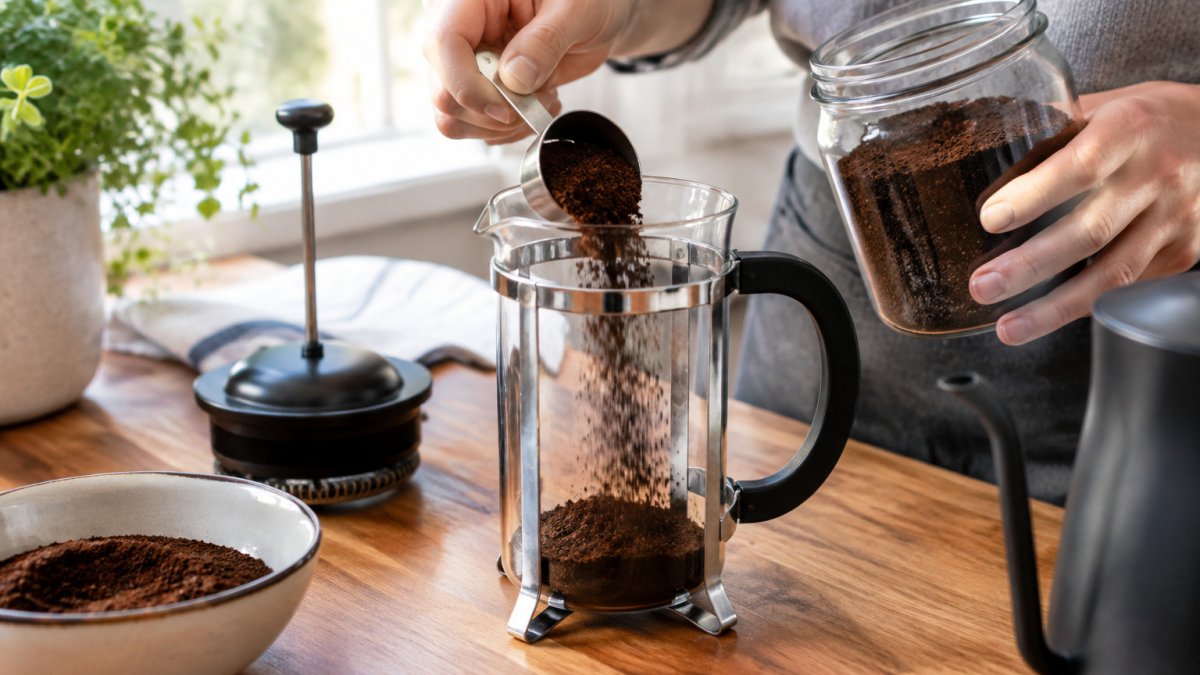
Whole bean versus pre-ground. Whole beans and grinding them yourself are a good option if possible. A burr grinder gives a more consistent coarse grind than a blade grinder, which produces uneven particles, boulders that under-extract alongside fines that over-extract and slip through the mesh. If you buy pre-ground coffee, check that it is labeled for French press or a coarse grind, and buy the smallest bag you will finish within a couple of weeks, because pre-ground coffee stales faster than whole bean.
The baseline brew. Start with a coffee-to-water ratio of about 1:15, roughly 30 grams of coffee for 450 grams of water, which yields about one 12-ounce mug. Use water just off the boil, around 195-205°F. Add the grounds, pour all the water at once, stir gently once to saturate, and steep for four minutes. Then press slowly and steadily. If the plunger fights back, your grind is too fine.
Dialing in by taste. Treat the grind as your main adjustment knob. If the cup tastes weak, sour, or thin, grind finer in small steps. If it tastes bitter, drying, or harsh, grind coarser. Change one variable at a time and keep the ratio and steep time fixed so you can tell what actually moved the flavor.
Grind-Size Troubleshooting and Sediment Control
If your cup tastes muddy or gritty, the grind is often the cause. Too fine a grind lets particles slip past the filter, leaving sediment at the bottom of the cup. Too coarse a grind can taste weak or sour because the water does not extract enough flavor. Here is how to diagnose and fix the three most common French press problems:
- Muddy, silty cup with sludge at the bottom. The grind is too fine, or the mesh is worn. Go one step coarser, and check that the filter screens are seated flat and not bent. A second, finer mesh screen or a paper filter disc placed over the mesh will catch more fines if you prefer a cleaner cup.
- Weak, sour, or tea-like cup. The grind is too coarse, the steep was too short, or the water was too cool. Grind finer, confirm a full four-minute steep, and use water at 195-205°F.
- Bitter, drying, or ashy cup. The grind is too fine, the steep ran long, or the roast is very dark. Coarsen the grind, cap the steep at four to five minutes, and pour off the coffee promptly.
To reduce sediment, pour your coffee into cups immediately after pressing rather than letting it sit in the carafe, where fines keep settling and extracting. Do not press the plunger all the way down and leave it there; stop just below the surface of the liquid. Rinse the carafe and mesh with hot water after every brew, and disassemble the filter every few weeks to clear trapped oils and fines. Adjusting the grind one step coarser often clears up a muddy cup within a single brew.
Watch out: blade grinders produce a mix of dust and chunks that no amount of ratio tweaking will fully fix, if muddy cups persist after coarsening, the grinder is the limiting factor, not the blend.
Best Supermarket Coffee for French Press vs. Freshly Roasted Blends
Supermarket coffee is convenient, but the bag in the aisle rarely tells you when it was roasted. Most mass-market bags carry a "best by" date instead of a roast date, and by the time you open one, much of the aroma has faded. Freshly roasted coffee is generally closer to its roast date when it is sold.
How to read a bag. Look for a printed roast date, not just a best-by date. Whole bean holds its flavor longer than pre-ground, so buy whole bean when you can and grind just before brewing.
Storage that actually works. Keep beans in an airtight, opaque container at room temperature, away from the stove, the oven, and sunlight. Buy in amounts you will finish in two to four weeks.
Cost per brewed cup. Bag price alone can be misleading, so compare cost per cup. At $23.99 per 12-ounce bag, a 12-ounce bag is about 340 grams; at a 1:15 ratio and roughly 30 grams per 12-ounce mug, that is about 11 brewed cups.
Where supermarket coffee still wins. It is available immediately and is easy to find in decaf. If you buy supermarket coffee for the press, choose whole bean over pre-ground, check the roast date when one is printed, and grind coarse at home.
Watch out: a recent roast date on a bag that has been sitting in a warm, sunny display does not guarantee fresh-tasting coffee, check the packaging and storage conditions, not just the date.
Choosing Your Blend and Placing Your First Order
Start with a medium roast such as the Breakfast Blend if you want something smooth and approachable. Choose the House Blend for more nutty, chocolate-forward balance, or the Cowboy Blend if you prefer bold, full-bodied coffee. The Latin American Blend is a medium-dark roast with nutty and cocoa notes.
Each blend is priced at $23.99. Order a few bags, compare them side by side, and keep notes on which one you reach for most.
Ready to brew better? Choose the blend that fits your taste and taste the difference that fresh, small-batch roasting makes. Shop Coffee at Black Cat Coffee Co. and find your new favorite French press cup.
Frequently Asked Questions
Which grocery store coffee is considered the best for a French press?
Supermarket coffee works well in a French press when it is labeled medium or medium-dark and sold as whole bean or ground coarse. Look for a roast date rather than a best-by date, since freshness affects the cup far more than brand name. Blends with chocolate and nutty notes tend to stay smooth and balanced through the French press steep. If a store bag has no roast date, it is usually older stock, and a freshly roasted bag from a specialty roaster will taste noticeably brighter and fuller.
What type of grind is best for French press coffee?
A coarse grind is the right choice for French press coffee. Fine grounds pass through the metal mesh filter and leave sediment in the cup, while coarse grounds stay behind the plunger. Aim for a texture similar to sea salt or coarse sand. Because the coffee steeps for about four minutes, a fine grind over-extracts quickly and turns bitter. If your cup is gritty, the grind is too fine or the plunge was too rushed.
Should you use a blend or single-origin coffee in a French press?
Blends are usually the easier choice for a French press because they are balanced by design. Combining beans from several origins smooths out acidity and gives a consistent body that holds up over a four-minute steep. Single-origin coffees, such as Sumatra or Brazil Santos, show distinct flavor character but can taste thin or sharp if the grind or ratio is off. Start with a blend, then move to a single origin once you have your grind and ratio dialed in.
How much coffee should you use in a French press?
A common starting ratio is about 1 gram of coffee for every 15 grams of water, which is roughly 2 level tablespoons of coarse ground coffee per 6 ounces of water. For a standard 34-ounce French press, that means about 55 grams of coffee to about 900 grams of water. Use water just off the boil, steep for four minutes, then press slowly. Adjust by about 10 percent up or down to match your taste.
